



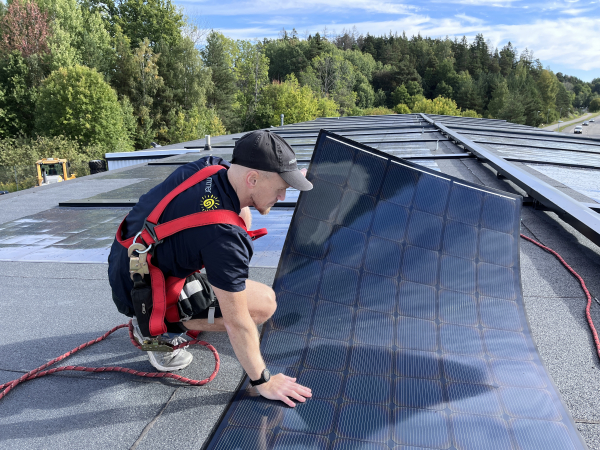
Swedish solar energy company Midsummer has secured the largest single solar panel order in its history, underscoring growing demand across Europe for lightweight, durable solar technologies designed for infrastructure projects where conventional silicon panels are less practical.
The company announced on July 27 (local time) in Stockholm that it will supply approximately 1,300 BOLD thin-film solar panels for a 667 kW off-grid installation covering more than 5,000 square meters. Delivery and installation are scheduled for the fourth quarter of 2026.
Rather than representing another utility-scale solar deployment, the project illustrates how Europe's renewable energy market is becoming increasingly specialized. Applications that require lightweight construction, transport flexibility, and resilient operation are creating opportunities for alternative photovoltaic technologies beyond traditional crystalline silicon.
Lightweight Solar Addresses Infrastructure Constraints
The project is being developed jointly with Denmark-based Green Energy Group, which specializes in sustainable solar solutions for transportation, mobility, and infrastructure applications.
According to Midsummer, its thin-film CIGS solar panels were selected because the installation required a combination of lightweight design, logistical efficiency, durability, sustainability, and a fully traceable European supply chain.
Such requirements are becoming increasingly important for off-grid infrastructure, remote installations, defense-related applications, and transportation projects, where roof loading capacity, difficult transportation routes, or harsh operating environments can limit the use of conventional solar modules.
Beyond Lowest Cost: Performance Becomes the Competitive Factor
Eric Jaremalm, CEO of Midsummer, said the contract represents the company's largest order both in installed capacity and commercial value.
He noted that customers are increasingly prioritizing reliability, low weight, and European manufacturing transparency rather than selecting solar panels solely on purchase price.
The company also emphasized that its panel architecture improves resilience against partial shading, severe weather, and physical damage through the use of diode protection between individual solar cells, helping maintain power generation even when portions of a panel are affected.
Why It Matters
The announcement reflects a broader structural trend within the renewable energy sector.
As electrification expands into transportation, defense, industrial facilities, remote infrastructure, and mobile platforms, demand is growing for solar technologies optimized for specific operating environments rather than maximum efficiency alone.
Thin-film photovoltaic technologies such as CIGS are increasingly competing not against silicon on cost, but on system integration, installation flexibility, transportation efficiency, and lifecycle resilience.
For Europe, this shift also aligns with broader efforts to strengthen regional clean-energy manufacturing and reduce dependence on global supply chains for strategic infrastructure.
