



Samsung SDS is expanding its AI business across data centers, cloud services and manufacturing systems. The company recently agreed to invest in U.S. AI infrastructure company Helix alongside other Samsung affiliates and is developing a platform that connects production equipment with robots. Its cloud business recorded double-digit revenue growth in the second quarter. These initiatives share a common direction: supplying the computing resources AI requires and applying the technology to enterprise systems and manufacturing operations.
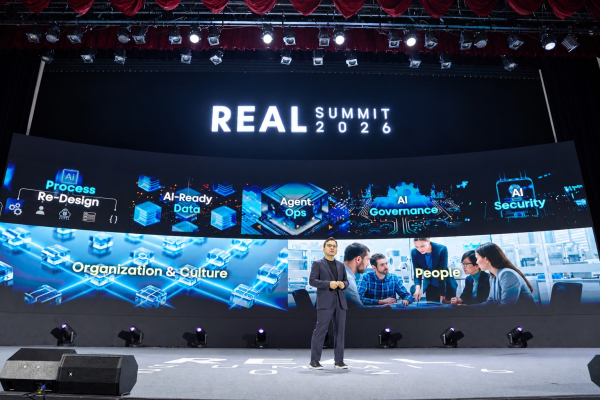
At REAL Summit 2026 in Seoul last month, Samsung SDS outlined a strategy combining AI infrastructure, platforms and solutions with consulting, development, implementation and operations. It aims to support customers from AI adoption through ongoing operations, taking account of their workflows and industry requirements. In manufacturing, the company is pursuing Robotics Transformation (RX), connecting robots with existing production systems. The plan extends its AI business from computing infrastructure and enterprise software to physical production environments.
Cloud Growth and Global AI Infrastructure Investment
According to preliminary second-quarter results announced on July 30, Samsung SDS recorded revenue of KRW 3.7178 trillion and operating profit of KRW 231.8 billion. These figures rose 5.9% and 0.7%, respectively, from a year earlier. Cloud revenue increased 17% to KRW 779.4 billion, while total IT services revenue grew 5% to KRW 1.7625 trillion. The results show cloud revenue growing faster than the broader IT services business.
Within cloud services, both infrastructure provision and customer system operations expanded. Revenue from the cloud service provider (CSP) business, which supplies the company’s own cloud infrastructure, rose 24% year on year, while revenue from managed service provider (MSP) operations, which support customers’ cloud deployment and management, increased 17%. Samsung SDS attributed CSP growth to demand for Samsung Cloud Platform (SCP) and expanded GPU cloud services for public-sector and external customers. Financial-sector AI transformation projects and shipbuilding enterprise resource planning (ERP) projects supported MSP revenue growth.
Samsung SDS is also expanding its AI computing services. It introduced an NVIDIA B300-based GPU cloud service in March and launched a neural processing unit (NPU) cloud service using FuriosaAI’s RNGD, pronounced “Renegade,” in July. These services provide GPU and NPU computing resources to meet customers’ AI requirements. They reflect the company’s existing business structure, which combines infrastructure provision with enterprise system implementation and operations.
In global infrastructure, Samsung SDS joined a collective investment by Samsung affiliates. On September 29, Samsung Electronics, Samsung C&T, Samsung SDS, Samsung SDI, Samsung Life Insurance and Samsung Fire & Marine Insurance announced an agreement to invest a combined $1 billion in Helix Digital Infrastructure. Samsung Electronics will contribute $500 million, with the other five companies contributing a combined $500 million. The announcement did not disclose Samsung SDS’s individual investment amount.
Founded by KKR (Kohlberg Kravis Roberts), Helix focuses on large-scale data centers, power generation and transmission, and fiber networks. The Samsung affiliates plan to explore cooperation drawing on their capabilities in semiconductors, cooling, construction, data center operations and power systems. Samsung SDS identified data center design, construction and operations, along with GPU cloud services, as its relevant capabilities. The announcement outlined the investment decision and intended cooperation but did not disclose Helix-related contracts or revenue for Samsung SDS.
Extending Manufacturing Systems Experience to Robotics Operations
In manufacturing, Samsung SDS is developing an integrated operations platform that connects production equipment with robots. At last month’s REAL Summit, the company announced its entry into the RX business and plans to introduce its robot orchestration platform from 2027. Orchestration means connecting multiple robots and pieces of equipment to coordinate tasks and manage operations. Samsung SDS is testing ways to automate manual factory tasks using robotics and physical AI.
The initiative builds on the company’s manufacturing systems experience. Samsung SDS said it has implemented manufacturing execution systems (MES) and equipment and logistics automation for approximately 430 customers over the past 25 years, spanning semiconductors, batteries, biotechnology, automotive, materials, components, and food and beverages. It is using that experience to develop robot-based manufacturing automation and technologies for managing production processes. The customer figure refers to its established manufacturing systems business, rather than adoption of the new robotics platform.
Samsung SDS is also working with physical AI companies. It announced a strategic investment in U.S.-based Walden Robotics through Samsung Venture Investment in June. Last month, it introduced its strategic partnership with Walden Robotics as part of its efforts to automate manual manufacturing tasks. The partnership focuses on connecting robotics technology with existing manufacturing systems.
A notable feature of Samsung SDS’s strategy is its extension of established capabilities into AI applications. In cloud services, computing resources and customer system operations are generating revenue, while in manufacturing, MES and automation experience underpin its work on integrated robotics operations. The Helix investment represents a separate initiative in global AI infrastructure cooperation. Although the three areas are at different stages, the strategy consistently combines infrastructure, system implementation and operational expertise.
The results reported so far include cloud revenue growth and the launch of AI computing services, while the robotics platform remains under development and validation. Samsung SDS has also outlined how it intends to apply its manufacturing experience to the new platform. Future performance will be measured by actual platform adoption, operating results and improvements in customer productivity. Its stated direction is to connect data center computing resources with practical AI use in enterprise workflows and manufacturing operations.
