



Research consortium to validate technology through GMP pilot production and pursue commercialization by 2029
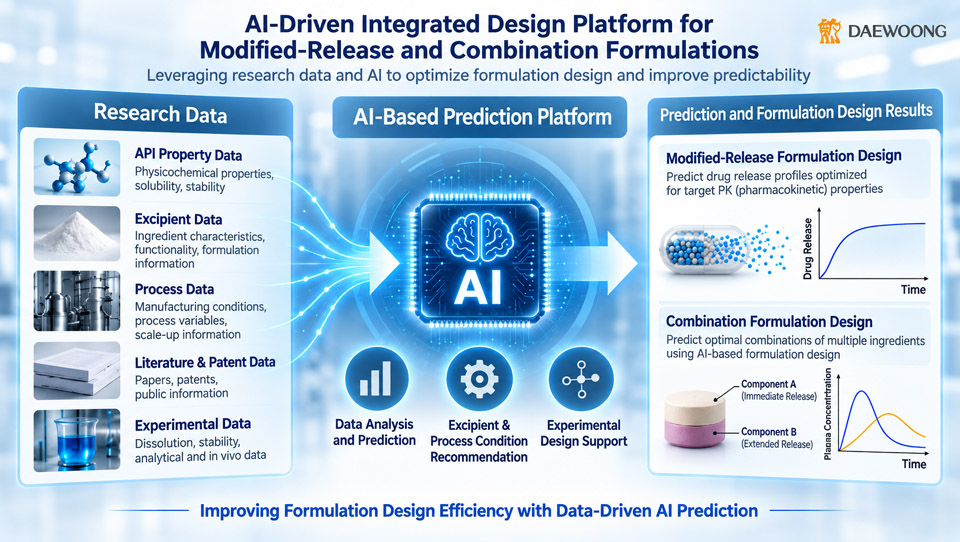
Daewoong Pharmaceutical is expanding its use of artificial intelligence (AI) beyond drug discovery into pharmaceutical formulation design, leading a South Korean government-funded project to develop a platform that identifies optimal drug formulations based on desired pharmacokinetic characteristics.
The company has been selected as the lead institution for the Ministry of Trade, Industry and Energy's national research project, "Development of an AI-Based Integrated Optimal Design Platform for Modified-Release and Combination Formulations," according to an announcement on September 28.
The project brings together Daewoong Pharmaceutical, Kookmin University, Chung-Ang University and AI pharmaceutical technology company AIJPharm.
The research consortium will receive approximately KRW 5.3 billion in total funding over three and a half years, from July 2026 through December 2029.
Reverse-Engineering Drug Formulations with AI
At the center of the project is an AI platform designed to work backward from a target pharmacokinetic (PK) profile to identify suitable drug formulations.
Rather than relying primarily on repeated experiments to determine how a formulation behaves in the body, researchers will first define desired characteristics, such as how quickly a drug is absorbed and how long its therapeutic effects should be maintained.
The AI system will then recommend formulation candidates, excipient combinations and experimental conditions that could achieve those objectives.
Pharmaceutical formulation development is a critical stage in drug development, influencing drug release, absorption, duration of action and patient convenience, even when the active pharmaceutical ingredient remains unchanged.
Traditionally, formulation scientists have relied heavily on experience and iterative experimentation, adjusting excipients, ingredient ratios and manufacturing conditions to achieve the desired performance.
Daewoong aims to shift this process toward a data-driven approach by combining its accumulated formulation research data with explainable machine learning and Design of Experiments (DoE) methodologies.
The platform will be designed to predict drug dissolution profiles, recommend appropriate excipients and identify experimental conditions, helping researchers narrow down potential formulations before conducting laboratory tests.
A central feature will be a continuous learning process in which AI-generated formulation candidates are experimentally validated, with the results subsequently fed back into the system to improve predictive accuracy.
This approach is intended to create a feedback loop between computational prediction and laboratory experimentation, progressively refining formulation design.
Simulating Gastrointestinal Conditions to Validate AI Predictions
The consortium will also develop a biorelevant dissolution testing system that reproduces the sequential environments of the stomach and small intestine.
The system will simulate how drugs dissolve and are released as they pass through the gastrointestinal tract, allowing researchers to connect experimental dissolution results with pharmacokinetic data.
By integrating these findings into the AI platform, researchers aim to improve the reliability of formulation recommendations and assess whether proposed formulations can achieve their intended pharmacokinetic profiles.
The initial research will focus on modified-release formulations before expanding to combination formulations.
Modified-release formulations are designed to control the timing or rate of drug release, while combination formulations incorporate multiple active pharmaceutical ingredients into a single dosage form.
Both present complex development challenges because their performance depends on numerous interacting formulation and manufacturing variables.
The consortium expects AI-based optimization to help researchers evaluate these variables more systematically.
From Laboratory Predictions to GMP Pilot Production
The project is designed to extend beyond computational modeling and laboratory-scale validation.
During the later stages of development, Daewoong plans to apply AI-recommended formulations and critical process parameters to its actual pharmaceutical development programs.
The company will also conduct pilot production under Good Manufacturing Practice (GMP) standards to assess whether the platform's predictions can be translated into practical manufacturing processes.
This validation stage will be important in determining whether the technology can move from a research tool to a platform suitable for routine pharmaceutical development.
The project reflects a broader expansion of AI applications in the pharmaceutical industry, from identifying potential drug candidates to optimizing how medicines are formulated and manufactured.
While AI-driven drug discovery has attracted considerable industry attention, formulation development represents another area where large datasets and predictive modeling could help reduce reliance on trial-and-error experimentation.
Because formulation scientists must evaluate numerous combinations of ingredients and processing conditions, the ability to identify promising candidates before laboratory testing could potentially reduce development time and experimental costs.
However, the practical benefits will depend on how accurately the platform's predictions perform under experimental and manufacturing conditions.
Commercialization Through a Subscription-Based Platform
Beyond improving its internal formulation research capabilities, Daewoong is pursuing the commercialization of the technology as a web-based subscription platform.
The consortium plans to validate the system in real-world research environments before exploring its use by external pharmaceutical companies and research institutions.
The strategy would extend the project beyond Daewoong's internal drug development operations, potentially creating a platform business serving the broader pharmaceutical and biotechnology research sector.
Park Sung-soo, CEO of Daewoong Pharmaceutical, said formulation research is a critical development process that determines pharmaceutical performance and patient convenience.
"Through this project, we will combine our accumulated research experience and data with AI to improve the speed and precision of formulation research and establish an AI-powered formulation design platform that can be applied in actual drug development," Park said.
The project is expected to continue through December 2029, with its commercial potential to be evaluated alongside research validation and GMP pilot production.
