



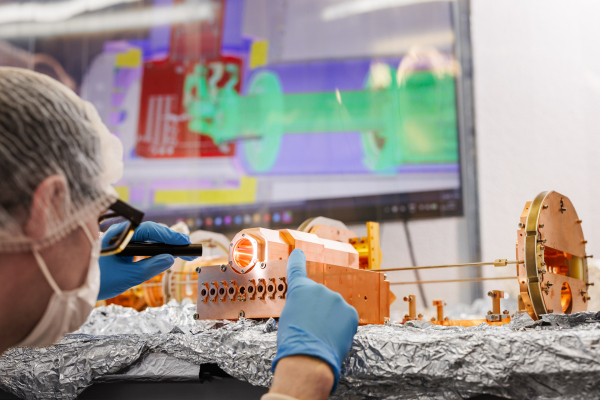
Swiss quantum computing startup ZuriQ announced on July 28 in Zurich, Switzerland, that it has secured $25.5 million in seed funding to accelerate development of its native two-dimensional trapped-ion quantum processor architecture, a technology designed to overcome one of the industry's biggest obstacles—scaling quantum computers from experimental systems to commercially useful machines.
The funding round follows the company's $4.2 million pre-seed financing in 2025 and was led by Quantonation, with participation from Forward.one, Extantia, Firgun Ventures and existing investors. ZuriQ said the investment will support recruitment, research and chip development as it works toward processors capable of integrating hundreds of qubits.
Rethinking Trapped-Ion Architecture
Trapped-ion quantum computing is widely regarded as one of the leading approaches for fault-tolerant quantum systems because of its high gate fidelity and long coherence times. Yet most existing platforms continue to rely on one-dimensional ion chains connected through increasingly complex junctions, making large-scale expansion progressively more difficult.
ZuriQ has adopted a fundamentally different approach. Its processors use Penning micro-traps, which replace rapidly oscillating electric fields with a static magnetic field, allowing ions to move freely across a two-dimensional chip without the junctions required by conventional architectures. According to the company, the design improves both qubit density and connectivity—two key requirements for practical quantum computing.
Professor Jonathan Home of ETH Zürich, who serves as a scientific adviser to ZuriQ, said the two-dimensional geometry enables qubit capacity to grow with the surface area of a chip rather than along a single linear chain, while also allowing much more flexible interactions between qubits.
From Laboratory Demonstration to Industrial Scale
ZuriQ has already demonstrated its architecture through a 3×3 array of nine individually controlled trapped ions, developed in collaboration with ETH Zürich. The processor chips were fabricated with Infineon, indicating that the design can be manufactured using established semiconductor processes.
Having validated both the architecture and fabrication pathway, the company is now focused on increasing qubit density and accelerating commercialization. Since 2025, ZuriQ has expanded its workforce from four to eighteen researchers and engineers, recruiting talent from organizations including IonQ, Xanadu, and Hamamatsu.
Chief Executive Officer Dr. Pavel Hrmo said the company deliberately chose to develop a native two-dimensional architecture rather than adapting conventional one-dimensional designs, believing the approach provides a more practical route toward large-scale quantum processors.
Why It Matters
As competition in quantum computing intensifies, the industry's challenge is no longer simply demonstrating more qubits, but building architectures that can scale to the thousands required for industrial applications.
While superconducting, photonic, neutral-atom and trapped-ion platforms continue to compete, architectural innovation is becoming an increasingly important differentiator. ZuriQ's announcement therefore represents more than another venture funding round—it reflects a broader industry shift toward processor designs intended to solve one of quantum computing's most persistent engineering challenges.