



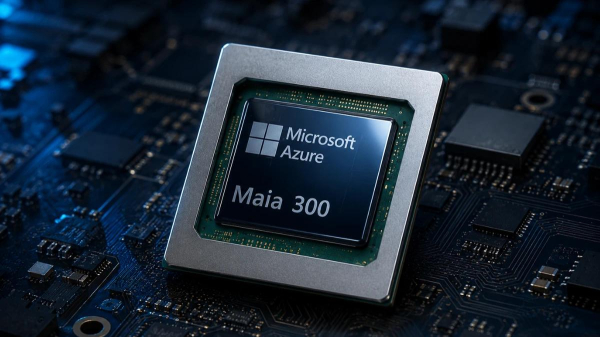
Microsoft has introduced power efficiency as a key competitive priority in AI semiconductors. On October 12, the company unveiled its next-generation AI accelerator, Azure Maia 300, and announced plans to expand its in-house chip systems to several gigawatts beginning in 2027. The strategy aims to reduce operating costs by delivering more AI services with limited power resources. It also signals a broader shift in AI infrastructure competition from securing chips to improving service productivity and profitability.
Microsoft expects Maia 300 to deliver approximately 40% higher AI throughput per megawatt than leading GPU-based systems. The measurement is based on tokens, the basic units that AI models process and generate. A server rack containing 96 accelerators is projected to deliver up to seven times the throughput of its predecessor, Maia 200. These figures represent Microsoft's performance targets and have yet to be independently verified under real-world operating conditions.
AI Chip Competition Expands Beyond Computing Power
Scott Guthrie, Microsoft's executive vice president of Cloud and AI, emphasized in the company's announcement that AI is becoming a foundational layer for applications and business processes. As enterprises move beyond conversational AI toward agents capable of performing complex tasks, data centers face growing computational workloads and electricity demand. Microsoft said Maia 300 is designed to support advanced reasoning, long-context processing and multistep AI operations.
As AI services expand, operating costs are becoming as important as semiconductor acquisition costs. Electricity, cooling, memory and networking all contribute to the economics of large-scale AI infrastructure. Processing more requests with the same amount of power can reduce the cost per service and improve data center profitability. Microsoft has therefore designed Maia 300 as an integrated system combining processors, memory and networking, using TSMC's N2P manufacturing process and HBM4 high-bandwidth memory to improve computational and data-processing efficiency.
Reducing Nvidia Dependence Creates New Opportunities for Korean Chipmakers
Microsoft's expansion of proprietary AI chips could reshape a supply chain dominated by Nvidia. Major cloud providers continue to purchase Nvidia GPUs while developing their own accelerators to diversify supply and control costs. AI inference workloads, in particular, vary in their computing and memory requirements, creating opportunities for specialized chips. Rather than replacing Nvidia products entirely, the strategy allows cloud providers to select hardware suited to specific services.
The shift could also create opportunities for South Korea's semiconductor industry. Maia 300's adoption of HBM4 highlights the growing importance of high-bandwidth memory not only in AI training but also in inference infrastructure. For Samsung Electronics and SK hynix, developing memory products and advanced packaging technologies tailored to proprietary AI accelerators could become an increasingly important competitive priority. However, actual suppliers, shipment volumes and pricing arrangements remain to be confirmed.
Greater power efficiency does not necessarily mean lower total electricity consumption. Even as individual chips become more efficient, rapidly growing demand for AI services could increase overall data center power usage. Evaluating AI infrastructure economics therefore requires more than comparing semiconductor performance. Electricity procurement costs, equipment utilization and the time needed to recover capital investment must also be considered.
The commercial performance of Maia 300 will become clearer after deployment begins in 2027. The key questions are whether Microsoft's projected efficiency gains translate into lower operating costs and whether its proprietary accelerators prove more economical than externally supplied GPUs. As AI infrastructure expands, competitive advantage will increasingly depend not only on access to computing hardware but also on how efficiently companies convert electricity and capital investment into reliable, revenue-generating AI services.
