



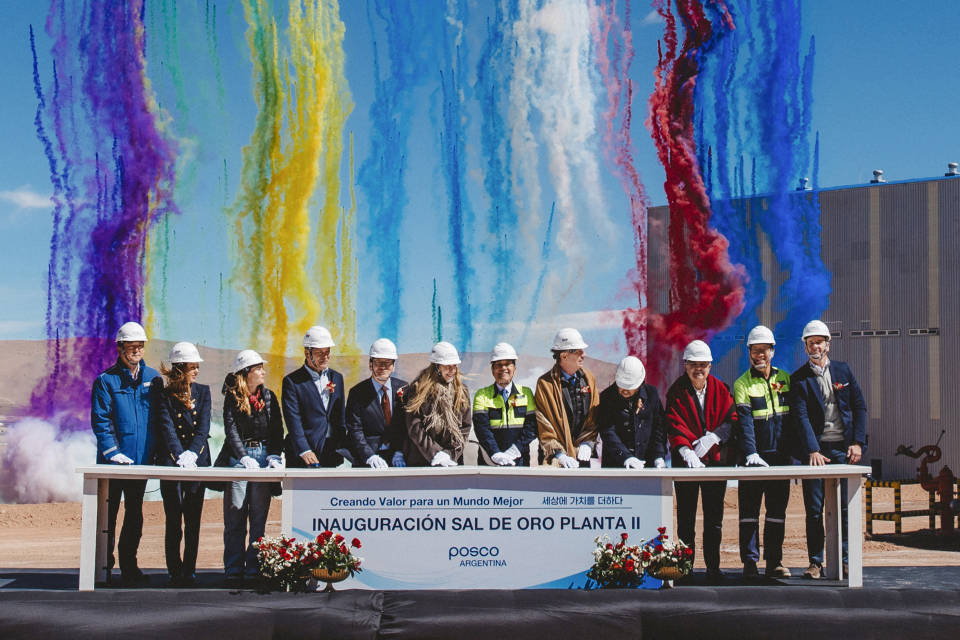
POSCO Holdings is accelerating its push into the global lithium market after completing the upstream portion of its second lithium brine plant in Argentina, strengthening the foundation for an annual production capacity of 50,000 tons of lithium hydroxide.
The company held a completion ceremony on October 6 at the Hombre Muerto salt lake in Argentina, located at an elevation of around 4,000 meters. POSCO Group Chairman Chang In-hwa and senior Argentine government officials attended the event, highlighting the strategic importance of the project to both sides.
The newly completed upstream facility represents a major step in POSCO’s long-term lithium strategy. With the second plant now adding 23,000 tons of annual lithium carbonate capacity, POSCO’s combined production capacity at Hombre Muerto has reached 48,000 tons per year, including the 25,000-ton capacity of its first plant.
POSCO Holdings invested approximately $954 million in the second facility. The lithium carbonate produced there is scheduled to be processed into battery-grade lithium hydroxide at a downstream facility being built in Korea’s Yulchon Industrial Complex in Jeonnam Province.
The Korean downstream plant, scheduled for completion in 2027, will have an annual production capacity of 25,000 tons of lithium hydroxide. When the two facilities are fully integrated, POSCO expects to establish a 50,000-ton annual production system based on lithium brine.
The project marks another milestone in POSCO Group’s efforts to secure critical battery minerals at the source rather than relying solely on external suppliers.
POSCO began developing its own lithium extraction technology in 2010, anticipating growing demand for lithium as electric vehicles and rechargeable batteries expanded. The group acquired mining rights to the Hombre Muerto salt lake in 2018 and completed its first commercial plant in 2024.
The latest investment also strengthens POSCO’s position in Argentina as the country seeks to attract large-scale investment in its mining and resources sector. POSCO Argentina secured approval under the government’s Regimen de Incentivo para Grandes Inversiones (RIGI) program in July, becoming the first Korean company to receive the investment incentives. The approval provides benefits including tax and customs-related support.
POSCO Argentina subsequently secured a $700 million short-term borrowing facility from IDB Invest in August, providing additional financial flexibility for its operations in the country.
POSCO is not stopping at the second plant. The company plans to accelerate preparations for its third and fourth lithium plants, each designed to produce 25,000 tons of lithium carbonate annually. The expansion would support POSCO’s goal of reaching 100,000 tons of annual lithium brine production by 2033.
The additional capacity is expected to position the group to capture growing demand from two areas of the battery market: lithium iron phosphate (LFP) batteries and energy storage systems (ESS), the latter of which is expected to benefit from the rapid expansion of AI data centers and their growing electricity requirements.
Rather than focusing exclusively on lithium hydroxide, POSCO plans to build a more balanced product portfolio covering both lithium hydroxide and lithium carbonate.
On the day of the completion ceremony, POSCO Argentina also signed memorandums of understanding with the governments of Salta and Catamarca provinces regarding the development of the third and fourth plants. The provincial governments agreed to support administrative procedures and permitting required for the projects.
Chairman Chang inspected the second plant during his visit and reviewed plans for the next phase of expansion with local officials. He also emphasized the importance of turning resource development into a stable source of production and earnings.
“By securing competitive resources ahead of demand and connecting them to production and profitability, we will strengthen the supply of critical minerals needed by Korean industry,” Chang said.
The expansion forms part of POSCO Group’s broader “Triple-Core” strategy, which identifies industrial resources, strategic resources and energy resources as key growth pillars.
For POSCO, the Argentine lithium business is therefore more than an overseas mining project. It represents an effort to build an integrated supply chain spanning resource acquisition, extraction, processing and battery-material production, while reducing Korea’s exposure to potential disruptions in the global critical-minerals market.
With the second plant now entering the final stage toward full-scale operations, POSCO Holdings is expected to focus on stabilizing production while laying the groundwork for its next round of expansion in Argentina.
