



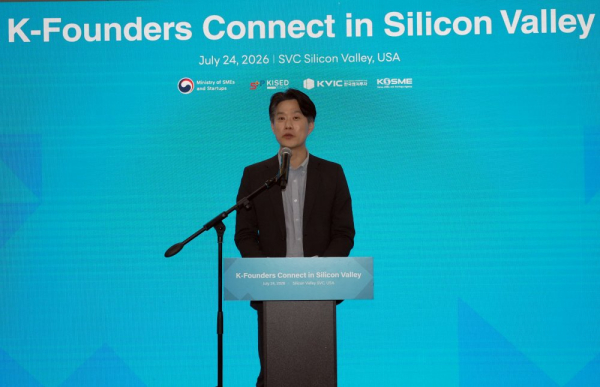
The South Korean government is extending its startup policy beyond national borders for the first time, creating a framework that enables Korean entrepreneurs overseas—including expatriates and international students—to build startups with direct government support while connecting them to global venture capital networks.
On July 24 (local time) in Silicon Valley, the Ministry of SMEs and Startups (MSS) hosted K-Founders Connect in Silicon Valley, bringing together approximately 70 participants, including Korean startup founders, venture capital investors, overseas Koreans, international students, startup support organizations, and government officials. During the event, the ministry unveiled the Global Startup for Everyone Project and officially launched the K-Founder Fund, a new overseas venture investment initiative expected to exceed KRW 100 billion (approximately US$70 million).
The announcements represent a significant shift in Korea's startup policy—from supporting companies founded inside Korea to cultivating Korean entrepreneurs wherever they choose to build their businesses.
Startup support expands to Koreans overseas
At the center of the new initiative is the Global Startup for Everyone Project, which extends government-backed startup support to overseas Koreans and Korean students studying abroad.
According to the ministry, the program was inspired by a proposal raised during the AI Connect Summit in Singapore earlier this year, where a Korean student called for policy support that would allow young Koreans overseas to pursue entrepreneurship on equal footing with founders in Korea.
The government plans to select approximately 80 promising entrepreneurs and aspiring founders from four major innovation hubs—Silicon Valley, New York, Singapore, and India. Participants will receive online and offline mentoring, customized incubation, startup activity funding, and connections to local business ecosystems.
A global mentor network will include experienced Korean entrepreneurs and investors such as Jung Hee Lee of Primer USA, Sunho Oh of Osteogene Tech, Juyoon Kim of Dot, and Seunghoon Lee, co-founder of Ringle. The mentors will provide practical guidance on customer acquisition, overseas fundraising, business expansion, and market entry.
The ministry also plans to leverage its overseas startup hubs, including the Korea Startup Center (KSC), to provide legal and regulatory guidance, market intelligence, technology validation opportunities, strategic partnerships, and investment support.
First overseas Korean venture fund launched
Another major announcement was the launch of the K-Founder Fund, the first government-backed venture fund built around the global Korean entrepreneurial network.
The fund, expected to exceed KRW 100 billion, will be established through Korea's Fund of Funds in partnership with successful overseas Korean entrepreneurs and investors.
The inaugural fund, ASQ Pioneer Fund, will be managed by Valon Capital.
Kim Dong-shin, co-founder of Silicon Valley unicorn Sendbird and the fund's manager, said the initiative will go beyond investment by working with communities such as United Korean Founders (UKF) to organize networking events, investor meetings, and startup demo days aimed at helping Korean startups expand internationally.
The ministry expects the fund to create a virtuous cycle in which successful Korean founders reinvest both capital and entrepreneurial experience into the next generation of globally minded startups.
Dialogue with Silicon Valley entrepreneurs
Earlier in the day, MSS also held a roundtable with Korean startups operating in Silicon Valley to identify challenges facing companies expanding into the U.S. market.
Representatives from seven Korean startups participated alongside officials from the Korea Technology Finance Corporation (KIBO), Stanford University's Stanford Consumer Accelerator (SCA), and the Korean startup network UKF.
Participants discussed financing, technology commercialization, market access, and collaboration among public institutions and private investors to strengthen the global competitiveness of Korean startups.
Stanford researcher Dahyang Jung introduced the SCA program, which supports Korean consumer startups—including companies in K-beauty and K-food—seeking to establish operations in the United States, while exploring future collaboration with the Startup Venture Campus in Silicon Valley.
Why it matters
The initiative marks a notable evolution in Korea's entrepreneurship policy. Rather than viewing startup support as a domestic program tied to Korea's borders, the government is beginning to treat the global Korean entrepreneurial community as part of a broader national innovation ecosystem.
If successfully implemented, the combination of overseas incubation, diaspora investment, and global mentoring could provide Korean founders with earlier access to international markets while strengthening the country's long-term position in the global startup economy.
