



Planned KRW 400 trillion Honam cluster moves forward as construction timing is reviewed alongside infrastructure plans
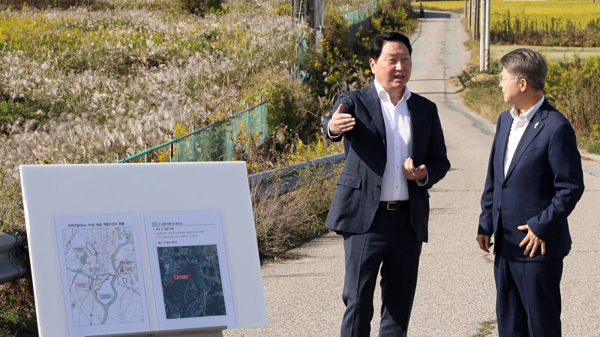
SK Group Chairman Chey Tae-won visited a proposed semiconductor complex site in Jeonnam-Gwangju Integrated Special City on October 9, pledging to accelerate development of a semiconductor cluster in the Honam region of southwestern Korea. He said semiconductor demand was rising faster than expected and that bringing forward the full completion of the Yongin semiconductor cluster by 12 years might still be insufficient. Chey raised the possibility of building fabs simultaneously in Yongin and Jeonnam-Gwangju as he assessed how quickly production facilities could be constructed at the new site. He said a specific groundbreaking date would depend on a coordinated review of site preparation, electricity and water supply plans, and construction schedules.
Chey toured the Gwangju military airport site and a nearby ammunition depot identified as a key candidate site for preparation, accompanied by SK hynix CEO Kwak Noh-jung and other senior executives. He met Min Hyung-bae, mayor of Jeonnam-Gwangju Integrated Special City, and other officials for a briefing on the industrial complex development plan and preparations for land, power, water and transport infrastructure. He then instructed executives to “work closely with the central and local governments to advance the southwestern semiconductor cluster as quickly as possible.”
At recent internal and external meetings, Chey has stressed the urgency of expanding production capacity, saying, “To lead in the AI era, we need to more than double memory semiconductor production capacity within the next five years.” During the visit, he reiterated that the pace of expansion must increase to keep up with demand. “Semiconductor demand is growing faster than expected, requiring us to accelerate the expansion of production facilities, and even though we have brought forward the overall construction schedule for the Yongin semiconductor cluster by 12 years, we expect that may still be insufficient,” he said. “We may need to build factories in Yongin and Jeonnam-Gwangju simultaneously.”
Full Yongin Completion Brought Forward by 12 Years, Honam Plan About Two-Thirds Its Size
During an on-site question-and-answer session, Chey explained that he had come because seeing the location firsthand was important. He said semiconductor demand was expected to continue growing rapidly, requiring a corresponding increase in the pace of production capacity expansion. He clarified that the 12-year acceleration referred to completing the development of the entire Yongin site, rather than opening a single fab. Even that accelerated plan might not meet demand, potentially requiring additional sites and simultaneous construction.
Chey said the facilities currently envisaged for Jeonnam-Gwangju would be about two-thirds the size of the Yongin cluster. He did not specify the number of fabs. He added that the Honam cluster could grow further if more land became available and demand increased. “This visit is to see firsthand how quickly we can build factories in Jeonnam-Gwangju,” he said, adding, “We will build as quickly as possible.”
Construction Timing Under Review as Power and Water Plans Are Coordinated
Chey said it was too early to give a definitive construction start date. Further calculations were needed to determine how local preparations and national water and electricity supply plans would align with construction. He suggested that related plans could be announced soon. Asked whether work could begin before the military airport was relocated, he said construction would proceed as quickly as possible once conditions allowed, while noting that the precise timing required further study.
Chey also raised the possibility of beginning construction before electricity and water infrastructure was ready. His remarks indicated that, if conditions permitted a start and the piling schedule could be coordinated, construction could proceed even if utility provision was delayed. He said saving on construction costs at the site was not a particular priority. The comments underscored his intention to secure additional capacity as quickly as possible to keep pace with demand.
“On behalf of the special city’s 3.2 million residents, I thank Chairman Chey Tae-won for clearly demonstrating his commitment to advancing the semiconductor cluster,” Min said. “We will firmly support not only essential infrastructure such as land, electricity and water, but also talent development and living conditions, so that SK hynix can reliably build and operate world-class semiconductor factories in an optimal environment.” The local government pledged to support workforce availability and residential conditions alongside the infrastructure needed for construction and operation.
SK hynix unveiled plans in June for a new KRW 400 trillion semiconductor cluster in the Honam region. Since then, executives have visited the Gwangju site about 10 times to hold discussions with the local government. Chey’s visit focused on inspecting the proposed site and infrastructure preparations, while setting a direction for faster implementation through cooperation with central and local authorities.
“Surging global demand for AI memory semiconductors is accelerating market growth, while competition is also becoming increasingly intense,” an SK hynix representative said. “With strong support from the central and local governments, we will continue investing at pace to help strengthen Korea’s leadership in AI semiconductors.”
