



Company focuses on faster deployment, power efficiency and scalable AI infrastructure
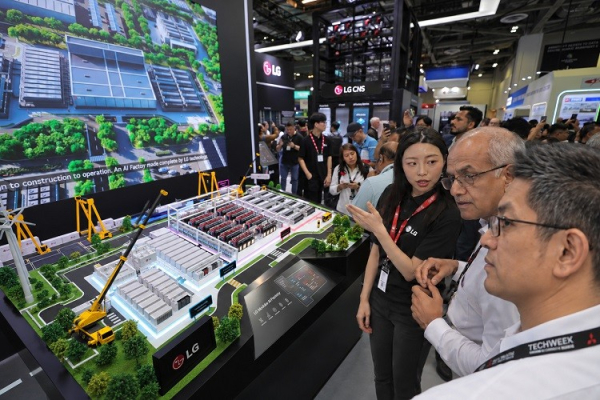
LG CNS is expanding its presence in the global artificial intelligence (AI) infrastructure market with modular data centers designed to address growing demand for faster deployment, high-density computing and scalable infrastructure.
The company showcased its next-generation AI infrastructure solutions at Data Centre World Asia 2026, held in Singapore on September 29-30. Key offerings included its Pre-fabricated Modular Datacenter (PMDC) and an AI Factory Full-Stack Service.
The move comes as AI data center operators face growing challenges in securing power, managing heat generated by high-performance GPUs and building infrastructure quickly enough to keep pace with demand.
PMDC is designed to address these challenges by standardizing GPUs, servers, power systems and cooling equipment into prefabricated modules that can be manufactured in advance and installed at the data center site.
Compared with conventional data center construction, in which mechanical, electrical and plumbing (MEP) systems and IT infrastructure are installed largely on site after the building is completed, the modular approach can reduce on-site work and shorten deployment time.
The modular architecture also allows customers to expand capacity as AI computing demand increases. Instead of building a large-scale facility upfront, operators can add modules incrementally based on actual demand.
Industry trends suggest that competition in the AI data center market is increasingly shifting beyond computing hardware toward infrastructure capabilities such as power availability, cooling efficiency, deployment speed and scalability.
The rapid adoption of high-performance GPUs has significantly increased power density and heat generation inside data centers, making power and thermal management critical considerations from the initial design stage.
LG CNS is incorporating capabilities from across the LG group into its PMDC offering. LG CNS provides data center design, build and operation capabilities, while LG Electronics contributes modular cooling infrastructure and LG Energy Solution provides battery solutions.
The company plans to use PMDC as a foundation for a modular AI Factory business. Under this model, customers can deploy container-based AI data centers without having to secure large sites or construct dedicated buildings. Additional containers can then be added as computing requirements increase.
LG CNS has introduced a 4-megawatt IT load module based on NVIDIA's next-generation Vera Rubin GPU architecture and a 1.2-megawatt module based on NVIDIA's GB300 platform. The company plans to expand its modular AI Factory lineup with different configurations to meet varying customer requirements.
LG CNS is also expanding its AI infrastructure business beyond physical facilities.
At Data Centre World Asia, the company introduced an AI Factory Full-Stack Service based on NVIDIA's next-generation Vera Rubin GPUs. The service combines GPU-as-a-Service (GPUaaS), intelligence services supporting real-time training and inference, and power and cooling technologies.
The strategy reflects a broader shift in the AI infrastructure market toward integrated solutions that combine computing resources, data center infrastructure and AI services rather than providing each component separately.
Cooling technology is becoming particularly important as GPU density increases. LG CNS has been strengthening its liquid-cooling capabilities for high-density AI computing environments, including direct-to-chip cooling infrastructure.
The company is also working with NAVER Cloud to build liquid-cooling infrastructure at a data center in Samsong, Goyang, South Korea. The facility is designed to support NVIDIA's next-generation Vera Rubin GPUs, with a total power capacity of 80 MW and the ability to accommodate high-density racks exceeding 200 kW per rack.
LG CNS is leveraging more than four decades of experience in data center design, construction and operation to expand its AI data center business.
The company has been upgrading infrastructure at existing domestic data centers for AI applications while strengthening its capabilities in high-performance GPU infrastructure. It is also pursuing overseas opportunities, including projects in Southeast Asia, North America and Europe.
The company's strategy is to move beyond project-based data center construction by commercializing standardized modules and combining GPUs, power, cooling and operational services. This could allow LG CNS to participate in a wider range of AI infrastructure projects, from initial deployment to subsequent capacity expansion.
Kim Tae-hoon, executive vice president and head of LG CNS's AI Cloud Business Division, said, “AI Factories are a total service that combines data centers, GPU infrastructure and AI services.”
“Customers will no longer want individual services. They will need integrated AI Factories that enable them to generate tangible business results through AI,” he added.
LG CNS said it will continue strengthening its AI infrastructure capabilities and expand its AI Factory ecosystem as it seeks to grow its global business.
