



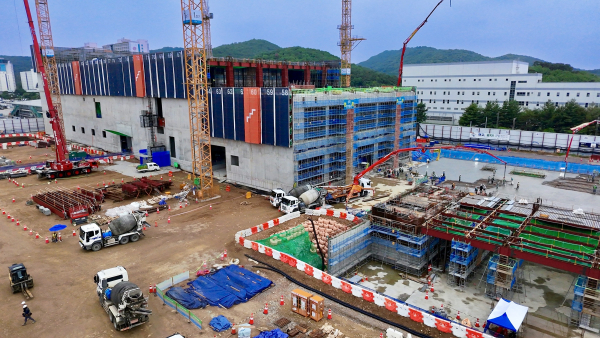
LG Uplus announced on the 5th that it has unveiled its next-generation AI data center infrastructure strategy at a construction site in Paju, Gyeonggi Province, setting a goal of securing cumulative orders worth KRW 5 trillion by 2030.
The company said the strategy is designed to establish a new global standard for AI infrastructure by leveraging synergies across LG Group affiliates under the “One LG” collaboration model, while strengthening the competitiveness of domestically developed AI infrastructure in the global market.
At the core of the strategy is the “The ACE on Trust” framework, which aims to overcome current limitations in AI data center development. The model combines Agility (rapid deployment), Capacity (power and scale), and Efficiency (cooling performance) on top of operational reliability, referred to as “Trust.”
LG Uplus noted that AI data centers are rapidly evolving as workloads shift from training to inference, leading to higher power consumption and heat generation. At the same time, the rapid advancement of GPUs and AI technologies has widened the gap between infrastructure demand and supply due to long construction timelines.
To address this, the company plans to introduce a prefabricated modular data center (PMDC) approach, in which key facilities are standardized and pre-built before being assembled on site. This method is expected to significantly shorten construction timelines by several months and allow flexible scaling from proof-of-concept to hyperscale facilities.
The Paju AI data center is also being built using similar modular construction techniques to accelerate deployment and better match rapidly growing AI infrastructure demand, which is increasingly driven by inference-based workloads and exponential growth in AI token usage.
In terms of capacity, the Paju facility will be supported by a confirmed 200MW power supply, making it the largest inference-focused AI data center in the Seoul metropolitan area. LG Uplus emphasized that this scale is currently unique in the region, as demand for AI data centers is shifting from around 30MW in the past to over 200MW in the current market.
The company added that it already operates major data centers in the Seoul metropolitan area, including its Pyeongchon facilities, and plans to expand capacity through both in-house development and partnerships with global investors and asset managers using a Design-Build-Operate (DBO) model.
For efficiency, the Paju AI data center will adopt a hybrid cooling system combining air and liquid cooling technologies—reportedly the first of its kind at hyperscale level in Korea. The facility has been designed from the construction stage to support high-density GPU workloads, including structural, waterproofing, and piping systems optimized for liquid cooling.
In collaboration with LG Electronics, LG Uplus has developed a direct-to-chip (D2C) liquid cooling system using cold plates and coolant distribution units (CDUs), which has demonstrated approximately 24% energy efficiency improvement compared to conventional air cooling.
Operational stability, or “Trust,” is based on LG Uplus’ 27 years of experience in data center operations with a 99.999% uptime record. The Paju facility will also incorporate robotics-based monitoring systems operating 24/7 to track temperature, humidity, leakage, dust levels, and perimeter security.
The company aims to evolve into an “AI Factory Operator,” integrating GPU resources, power management, and cooling systems into a unified platform that operates like an industrial production facility optimized for AI workloads.
Key infrastructure components of the Paju data center will be developed through collaboration within the “One LG” ecosystem. LG Electronics will supply cooling systems including free cooling chillers, while LG Energy Solution will provide UPS battery systems designed with multi-layer safety features to prevent thermal runaway. LG Uplus is also co-developing an 800V DC power distribution system with LS Electric.
An AI-based DCIM (Data Center Infrastructure Management) system is also under development to integrate and automate operations across all infrastructure components.
According to LG Uplus, the AI data center business is expected to generate more than KRW 1 trillion in annual orders by 2030, contributing to an overall compound annual revenue growth rate of 15–20%. The first building of the Paju AI data center, scheduled for completion in June next year, is already fully contracted.
