



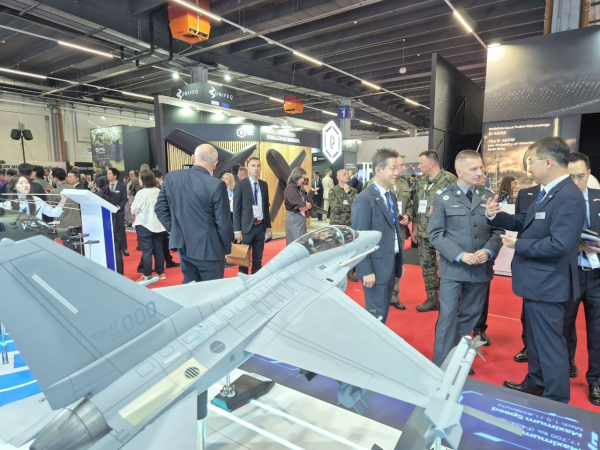
Korea Aerospace Industries (KAI) is stepping up efforts to expand its footprint in the European defense market by showcasing a range of manned and unmanned combat systems at MSPO 2026 in Poland.
The company is participating in the 34th International Defence Industry Exhibition, held in Kielce from Sept. 8 to 11, where it is presenting not only its flagship aircraft but also a broader vision for next-generation aerial warfare.
A key focus of KAI’s exhibition is its Next Generation Aerial Combat System (NACS), which integrates the KF-21 fighter jet with unmanned combat aerial vehicles (UCAVs), advanced multi-purpose unmanned aircraft and low-Earth-orbit communications satellites.
Through the system, KAI is outlining a development pathway for the KF-21 that could eventually enable the platform to evolve toward sixth-generation combat capabilities. The company is positioning the concept as a networked combat architecture rather than simply a next-generation fighter aircraft.
KAI is also highlighting the future expansion of its FA-50 platform through manned-unmanned teaming (MUM-T). The company is displaying a FA-50 configuration linked with an advanced multi-purpose unmanned aircraft, demonstrating how the light combat aircraft could take on expanded missions by operating alongside unmanned assets.
The FA-50 has become a key entry point for KAI into the European defense market. Poland signed a contract for 48 FA-50 aircraft with KAI in 2022, establishing the country as a strategic foothold for the Korean company in Europe. KAI is now seeking to leverage the platform's growing presence in Poland to pursue additional opportunities across neighboring markets.
The company is taking a similar approach in the rotary-wing sector.
At MSPO, KAI is presenting manned-unmanned teaming concepts that combine its Marine Attack Helicopter (MAH) and Light Armed Helicopter (LAH) with air-launched effects (ALE). The integration is designed to expand reconnaissance and strike capabilities while improving the survivability of manned helicopters in complex combat environments.
The MAH is receiving particular attention following the successful completion of its system development in August. KAI plans to use the exhibition to introduce the platform to European countries considering helicopter fleet replacement and modernization.
KAI is also using MSPO as a platform to identify new customers and follow-on programs. In addition to pursuing further opportunities in Poland, the company plans to meet defense officials and industry representatives from countries including Romania, Bulgaria and Slovenia, where demand for fighter replacement and modernization remains a potential market opportunity.
The company’s strategy reflects a broader shift in European defense procurement toward networked platforms and unmanned technologies. Rather than competing solely on individual aircraft, KAI is seeking to demonstrate how its fighters and helicopters can operate as part of integrated manned-unmanned combat networks.
“Interest in the KF-21 is growing as the performance and reliability of Korean aircraft have been demonstrated through the FA-50 program in Europe,” said Kim Ji-hong, executive vice president of KAI. “As customers show increasing interest in manned-unmanned teaming, we will continue strengthening the position of Korean aircraft across Europe, using Poland as a strategic base.”
KAI has been strengthening its local presence in Poland as part of its European expansion strategy. The company established a base office at Minsk Mazowiecki Air Base in 2023 to provide customer and technical support for the Polish FA-50 program.
In June last year, KAI also established a European subsidiary in Warsaw, providing the company with a local platform for expanding business opportunities and diversifying its export activities.
With the FA-50 providing an established customer base and the KF-21 and unmanned systems opening new avenues for growth, KAI is increasingly positioning Europe as a key market for its next phase of global expansion.
