



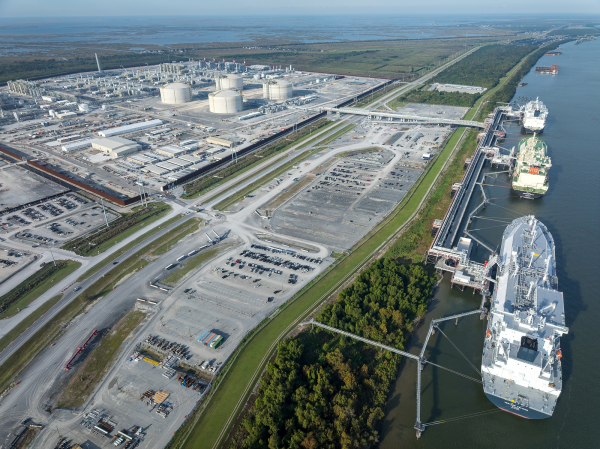
NG carriers are docked at a U.S. production facility. Through Hanwha Horizon USA, Hanwha Aerospace is integrating the procurement, transportation and sale of U.S. LNG to build a global value chain connecting North America with Korea and other Asian markets. / Courtesy of Hanwha Aerospace
Hanwha Aerospace has established Hanwha Horizon USA to manage liquefied natural gas procurement, sales, trading and logistics. The move extends the South Korean defense group into energy trading while linking U.S. LNG supplies with Hanwha’s shipping, shipbuilding and power-generation businesses.
The new entity is designed to turn fuel procurement for an affiliated power plant into a broader commercial platform. By coordinating long-term contracts, vessels, cargo schedules and downstream demand, Hanwha aims to capture value across the LNG chain rather than remain a single-market buyer.
Hanwha Horizon USA will be led by James Sagar, chief executive officer of Hanwha Shipping, who has more than 30 years of experience in the maritime and energy industries. His dual role places shipping at the center of the business, where freight costs, vessel availability and delivery flexibility can determine the economics of each cargo.
“The launch of Hanwha Horizon USA is a turning point that connects our global LNG procurement capabilities with our shipbuilding and maritime businesses,” Sagar said. He added that the company intends to build a supply chain capable of responding flexibly to market changes.
The entity’s first customer will be Hanwha Energy’s LNG power plant in Yeosu, South Korea, scheduled to begin commercial operation in 2029. Hanwha then plans to expand sales to other power producers and energy companies before entering LNG trading across Asia and other markets.
From fuel procurement to portfolio trading
Hanwha Aerospace has already secured its anchor supply. In February, it signed a 20-year agreement with U.S. producer Venture Global to purchase 1.5 million tonnes of LNG annually from 2030. The contract covers approximately 30 million tonnes and is Venture Global’s first long-term LNG agreement with a Korean company.
The timing exposes an immediate operational test. The Yeosu plant is due to start operating in 2029, one year before Venture Global deliveries begin. Unless either schedule changes, Hanwha will need bridge supplies through spot purchases, shorter-term contracts or another LNG portfolio.
That gap illustrates why Hanwha Horizon USA will manage trading and logistics as well as procurement. The value of LNG is shaped not only by the contract price but also by shipping rates, available vessels, destination rights, seasonal demand and regional price differences. The ability to redirect cargoes can convert a fixed supply commitment into a tradable portfolio.
The scale of the Venture Global contract also supports ambitions beyond the Yeosu plant, although Hanwha has not disclosed the facility’s expected annual consumption. Its plan to serve third-party power producers suggests that contracted cargoes may eventually be marketed externally or allocated among customers according to demand and price conditions.
Hanwha has separately signed a memorandum of understanding with Korea Southern Power to pursue joint procurement and diversify supply sources. Aggregating demand from multiple buyers could strengthen purchasing power and improve vessel utilization, though no binding volume has been announced.
The U.S. entity complements Hanwha Energy’s Horizon LNG trading subsidiary, established in Singapore in 2023. Singapore provides access to Asia’s principal trading and demand center, while Hanwha Horizon USA moves the group closer to U.S. producers and export terminals. Together, they form the outline of a North America-to-Asia trading corridor.
Defense cash flow supports an energy platform
Hanwha Aerospace is an unconventional anchor for an LNG business, but its financial position is strategically useful. The company, whose portfolio includes the K9 self-propelled howitzer, Redback infantry fighting vehicle, munitions and aircraft-engine components, is using the strength of its expanding defense business to support long-dated energy commitments.
S&P Global Ratings assigned Hanwha Aerospace an “A-” long-term issuer rating with a stable outlook in June, citing its approximately 37 trillion won order backlog and growing defense exports. Access to international debt markets matters in LNG trading, where multidecade purchase obligations, shipping capacity and working capital can require substantial financing.
Hanwha Group also controls much of the infrastructure needed to execute the strategy. Hanwha Energy provides power demand, Hanwha Ocean builds LNG carriers, and Hanwha Shipping offers a platform for vessel ownership and operation. Hanwha Philly Shipyard adds a U.S. industrial base connecting American energy exports with the group’s shipbuilding expansion.
The resulting model is mutually reinforcing: long-term LNG purchases create transportation demand; shipping operations generate cargo and freight intelligence; shipbuilding supports fleet requirements; and power plants provide an initial customer base. The competitive advantage will come from coordinating these assets, not simply owning them.
The strategy also expands U.S.–Korea industrial cooperation beyond defense and shipbuilding. The United States gains a long-term LNG buyer and maritime investor, while Korea secures a more diversified energy supply and deeper access to U.S. industry. Energy security, commercial shipping and defense production are converging within the same bilateral supply-chain architecture.
The risks are equally integrated. A 20-year contract improves supply security but increases exposure to LNG price declines, tighter emissions rules and weaker gas-fired power demand. Hanwha Horizon USA will therefore be judged less by the volume it secures than by how effectively it manages contract flexibility, freight costs and surplus cargoes.
Hanwha is not merely buying American LNG. It is using energy flows to connect finance, shipping, shipbuilding and strategic industry across the Pacific. Hanwha Horizon USA is the commercial hub intended to make that integration work.
