



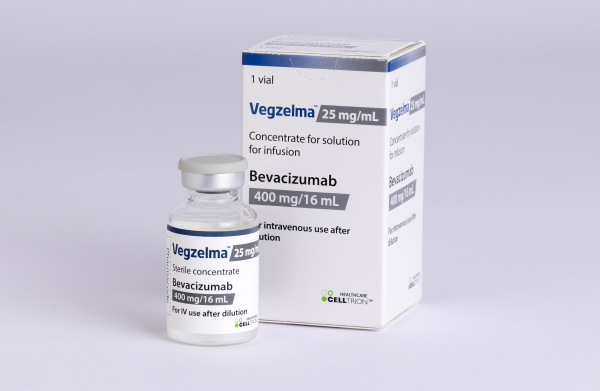
Celltrion said Friday that an integrated population pharmacokinetic analysis of its bevacizumab biosimilar Vegzelma has confirmed pharmacokinetic similarity with the original drug Avastin.
The findings were published in BioDrugs, an international peer-reviewed journal specializing in biotechnology and pharmacology.
Vegzelma, also known by its development code CT-P16, is a biosimilar of Avastin, which is used to treat several cancers, including metastatic colorectal cancer and breast cancer.
The study combined data from two global Phase 1 trials conducted in healthy participants and one global Phase 3 trial involving patients with nonsquamous non-small cell lung cancer (NSCLC).
Researchers from Celltrion and a team led by Professor Min-jung Jang of Yonsei University analyzed data from 834 participants and more than 8,000 serum concentration measurements.
Using the combined dataset, the researchers developed a population pharmacokinetic model to compare how Vegzelma and the reference product behave in the body.
The analysis found that Vegzelma demonstrated pharmacokinetic characteristics comparable to those of the reference product marketed in the United States and Europe. No clinically meaningful differences were observed in clearance, which indicates the rate at which a drug is eliminated from the body, or central volume of distribution, a key measure of how a drug is distributed within the body.
Population pharmacokinetic modeling is a statistical approach that uses clinical data to assess how drugs are absorbed, distributed and eliminated across different individuals. The methodology is increasingly being used by global pharmaceutical companies to support drug development and comparative assessments.
Celltrion said the study is significant because it goes beyond the initial demonstration of biosimilarity by integrating data from different stages of clinical development to generate additional evidence supporting Vegzelma’s pharmacokinetic profile.
The company plans to continue generating clinical and academic data after regulatory approval, rather than limiting its evidence base to the studies required for approval. Celltrion aims to use these findings to provide physicians with broader evidence to support prescribing decisions and strengthen Vegzelma’s competitiveness in global markets.
Vegzelma has also been expanding its presence in major overseas markets. According to IQVIA and local market data cited by Celltrion, the biosimilar reached an estimated 10.6% share of the U.S. market as of May, surpassing the 10% mark for the first time since its launch.
In Japan, Vegzelma held an estimated 64% market share as of March, maintaining its leading position in the country.
Industry analysts say the results highlight the growing importance of clinical and academic evidence in the biosimilar market, where competition is increasingly extending beyond price to include physicians’ confidence and the breadth of supporting clinical data.
A Celltrion official said the publication in an international peer-reviewed journal provides further objective evidence of Vegzelma’s performance.
“Even as regulatory agencies streamline clinical requirements for biosimilar approvals, Celltrion will continue to accumulate extensive clinical evidence after approval to strengthen confidence among healthcare professionals and accelerate the expansion of our global market share,” the official said.
