



New packaging approach targets next-generation HBM5 and ultra-high-density AI systems
As competition intensifies in the high-bandwidth memory (HBM) market — a critical component for AI semiconductors — SK hynix has introduced a next-generation packaging technology designed to fundamentally address heat generation inside AI memory systems.
Rather than relying solely on external cooling solutions, the company unveiled a structural thermal management approach that embeds dedicated heat dissipation pathways directly inside the HBM architecture, a move industry observers say could become a key enabler for future high-performance AI infrastructure.
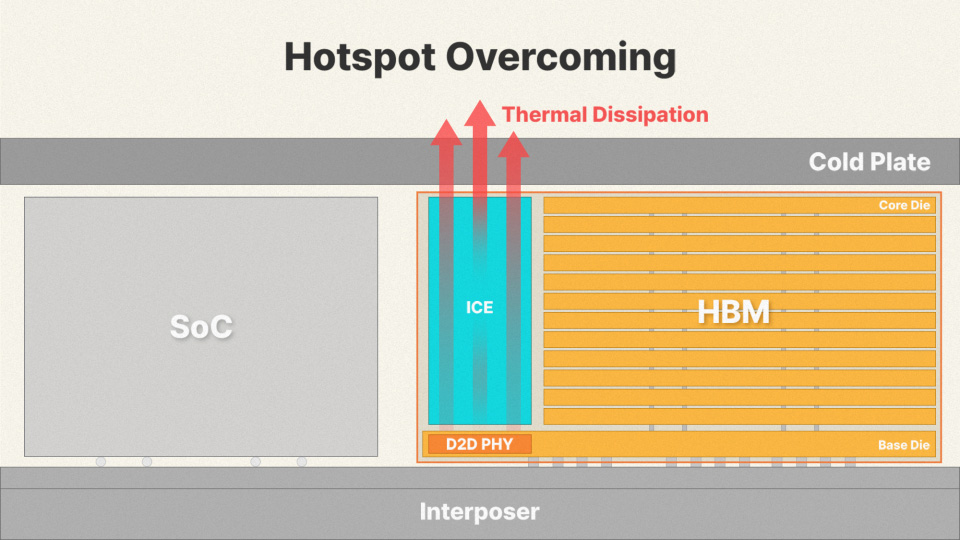
SK hynix announced on Thursday that it has developed a new technology called “iHBM (Integrated HBM),” which integrates cooling components directly into the internal HBM package structure. The core of the technology involves silicon-based cooling elements known as ICE (Integrated Cooling Elements), which are positioned inside the memory stack to rapidly transfer heat outward.
The announcement comes as the rapid expansion of generative AI and large language models (LLMs) drives a sharp increase in AI accelerator workloads. To meet growing performance demands, HBM chips are evolving toward higher stacking densities and faster data transfer speeds. However, the resulting increase in heat generation has emerged as one of the industry’s biggest technical challenges.
In particular, the Die-to-Die (D2D) interface area connecting HBM and GPUs is considered one of the hottest sections within AI packages due to concentrated data movement. Conventional HBM structures transfer heat through multiple die layers before reaching external cooling systems, limiting thermal efficiency.
SK hynix said its iHBM technology redesigns the internal structure by inserting cooling elements directly into the D2D PHY region, where heat concentration is highest. The company explained that the dedicated thermal pathway allows heat to move directly outward without detouring through stacked layers.
According to SK hynix, the technology reduces internal package thermal resistance by more than 30% compared with existing approaches, enabling stable operation even under high-temperature conditions.
Industry analysts believe cooling technologies will become increasingly important as HBM stacks continue to grow taller and more densely integrated. Without effective thermal control, excessive heat can reduce processing performance, lower power efficiency, and shorten product lifespan.
In that context, iHBM is being viewed not simply as a packaging improvement, but as a potential core technology that could determine competitiveness in next-generation AI memory platforms.
SK hynix also emphasized manufacturability. The company said the technology leverages its commercially proven Advanced MR-MUF-based wafer-level packaging (WLP) process, allowing scalable mass production. It also noted that the solution offers high compatibility with existing system-in-package (SiP) environments used by customers, minimizing the need for major redesigns.
The company plans to gradually apply iHBM technology to future HBM product families, including HBM5. SK hynix aims to strengthen its leadership in the AI memory market by improving thermal stability and power efficiency for ultra-high-bandwidth, ultra-high-density AI data center and high-performance computing (HPC) environments.
“iHBM is a new thermal management solution combining advanced packaging technology with memory design capabilities,” said Lee Kang-wook, Vice President and Head of Package Development at SK hynix. “We will continue expanding our leadership in next-generation memory technologies by proactively delivering the performance and stability demanded in the AI era.”