



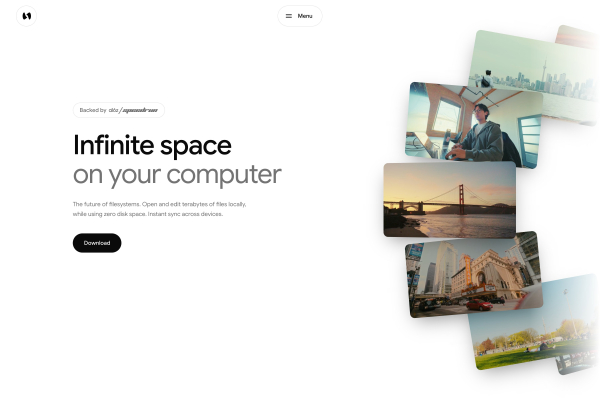
Space, a San Francisco-based infrastructure startup, announced on August 18 that it has raised $2.4 million in pre-seed funding to develop a distributed filesystem designed for human users and artificial intelligence agents.
The round was led by a16z Speedrun, with participation from Golden Ventures, Northside Ventures and 12 angel investors with backgrounds in consumer and enterprise software companies, including Parsec, Sentry, Stan, Superwhisper and Modem.
Space is developing an AI-native distributed filesystem that brings cloud storage and local drives into a shared data layer. The platform is designed to let applications, team members and AI agents work with the same live files as though they were stored locally, without downloading entire files, creating duplicate copies or building a separate integration for each application.
The company’s premise is that cloud platforms have largely solved where data is stored, but AI is making immediate access to that data a new infrastructure constraint. Design files, software repositories, datasets, media libraries and machine-generated outputs are increasingly spread across clouds, drives and devices, yet users and AI systems must often move, copy or process the data before work can begin.
Space seeks to address that constraint by introducing an access layer directly above the operating system. Cloud-hosted files appear in tools such as Finder and can be opened through existing native applications without being permanently stored on the user’s device.
When an application or AI agent requests information, the system streams only the byte ranges required for the task in real time. This could allow a video editor to open a project larger than the computer’s available storage, an architect to work with a large building model or an AI agent to examine relevant portions of an organisation’s files without copying the entire dataset.
“Humans and agents are working across more data than any local disk can hold. They should not have to wait for files to be copied or ingested before work can begin,” said Jason Zhao, co-founder of Space.
Arihant Bapna, co-founder of Space, said the filesystem is the common layer connecting applications, devices, users and agents. Rebuilding it around live, distributed data, he said, could make the workflows operating above it faster.
Unlike conventional cloud-storage services built primarily around file synchronisation or browser-based applications, Space operates at the filesystem level. The company says this allows software such as Adobe Premiere, DaVinci Resolve, Blender, computer-aided design tools and code editors to work with remote data without requiring dedicated connections to individual services.
The architecture also addresses an emerging inefficiency in agent-based computing. Many AI tools require users to upload an entire file even when a task involves only one page, video frame or segment of data. Space is designed to let agents navigate the shared filesystem and retrieve only the information relevant to a particular operation.
Space is currently operating in private beta, with approximately 100 individual and team users. The company also says it has built an organic audience of more than 80,000 people across online platforms.
From large-file bottleneck to infrastructure startup
Space was founded by Matthew Ao, Arihant Bapna and Jason Zhao after they encountered large-file management problems in their own creative and business operations.
Zhao had accumulated dozens of terabytes of video footage while documenting his life on YouTube over the past decade. At the founders’ previous company, the team transferred terabytes of footage each month, losing time to uploads and downloads and sometimes interrupting work when physical drives were unavailable.
The founders built the first Space prototype in November 2025. The team subsequently worked out of Founders Inc. in San Francisco while raising its pre-seed round.
“Space is disrupting one of the oldest assumptions in computing: a file has to exist on your device before you work with it,” said Jonathan Lai, general partner at a16z. He said the company’s filesystem could give human creators and AI agents immediate access to the specific data required for a task.
From filesystem to ‘infinite computer’
Space will initially target teams in video production, marketing, architecture, engineering and construction whose workflows already exceed the storage capacity of local devices. These sectors are also adopting agent-based workflows in which people and AI systems must operate across the same large volumes of live, unstructured data.
The company then plans to expand into AI-native businesses and other data-intensive fields, including media and entertainment, AI training-data infrastructure, computer vision, enterprise data systems and world-model development.
The filesystem is Space’s entry point toward what it calls the “Space Computer,” or the “infinite computer.” Its longer-term vision is an architecture in which a physical device serves as a window into effectively unlimited cloud-based storage and computing resources, rather than being constrained by the capacity of the machine itself.
