



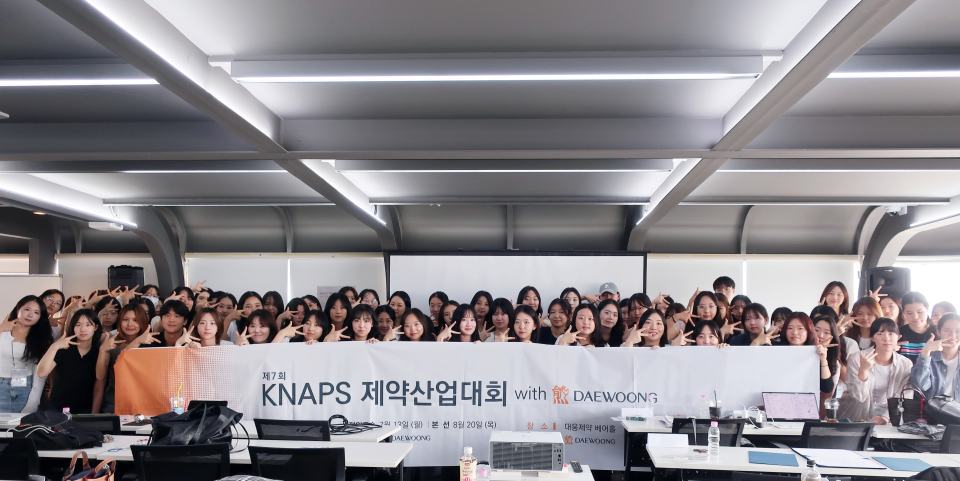
Daewoong Pharmaceutical is strengthening its efforts to nurture the next generation of global pharmaceutical talent by giving Korean and Indonesian pharmacy students hands-on experience in developing an overseas market-entry strategy.
Daewoong Pharmaceutical said on Oct. 7 that it successfully completed the Industrial Skills Event (ISE), an industry-academia collaboration program conducted with the Korean National Association for Pharmaceutical Students (KNAPS). A total of 80 students participated, including 48 pharmacy students from Korea and 32 students from the Indonesian pharmacy student organization BEM Fakultas Farmasi Universitas Indonesia (BEM FF UI).
The central assignment was to develop a market-entry strategy for Daewoong Pharmaceutical’s pain-relief brand EasyN6 Eve in Indonesia.
The project began with online workshops in which Korean and Indonesian students worked together in teams. Participants examined the Indonesian pharmaceutical market and consumer needs before developing strategies covering product positioning, distribution and marketing.
The program culminated in team presentations, with Daewoong Pharmaceutical employees serving as mentors and judges. The company’s working-level staff provided feedback on the feasibility and practical application of each proposal from an industry perspective.
The winning team focused on women experiencing menstrual pain and related discomfort, including bloating and abdominal swelling. The students proposed a targeted positioning strategy combined with a distribution model linking local pharmacies with digital channels.
The project highlights a growing emphasis within the pharmaceutical industry on practical global-market experience for future talent. Rather than limiting the program to classroom-based learning, students were asked to tackle a real-world market-entry challenge and develop a strategy from consumer research through commercialization.
The participation of Indonesian pharmacy students also added a local perspective to the project. Their understanding of local consumers and market conditions helped Korean participants identify factors that could be overlooked when approaching the Indonesian market from Korea alone.
Industry observers say such cross-border industry-academia programs can provide value beyond talent development. For pharmaceutical companies expanding overseas, access to local market insights and professionals capable of translating those insights into commercial strategies is becoming increasingly important.
The program also provided Daewoong Pharmaceutical with an opportunity to engage directly with young talent interested in the global pharmaceutical industry. As Korean pharmaceutical companies accelerate their international expansion, collaboration with universities and student organizations is expected to become an increasingly important tool for developing globally oriented talent.
The winning team, consisting of pharmacy students Kim Yoon-seo, Kim Min-joo and Kim Min-jung from Ewha Womans University, said the project was particularly meaningful because they were able to identify the core value of EasyN6 Eve based on Indonesian consumer needs and consider how the product could establish itself in the local market.
Park Eun-kyung, head of Daewoong Pharmaceutical’s CH Division, said the company was impressed by the creative ideas generated through collaboration between students from the two countries.
“We were able to see the strong potential of young talent through the fresh ideas developed from the perspectives of students in both countries,” Park said. “We will continue to expand industry-academia collaboration opportunities so that young people can build practical capabilities needed in the global pharmaceutical industry.”
