



South Korea's Ministry of SMEs and Startups (MSS) has unveiled a new policy agenda designed to strengthen the country's innovation economy by supporting startups and small businesses from their earliest stages through global expansion. AI, advanced manufacturing, biotechnology and climate technology will be the primary focus of the initiative.
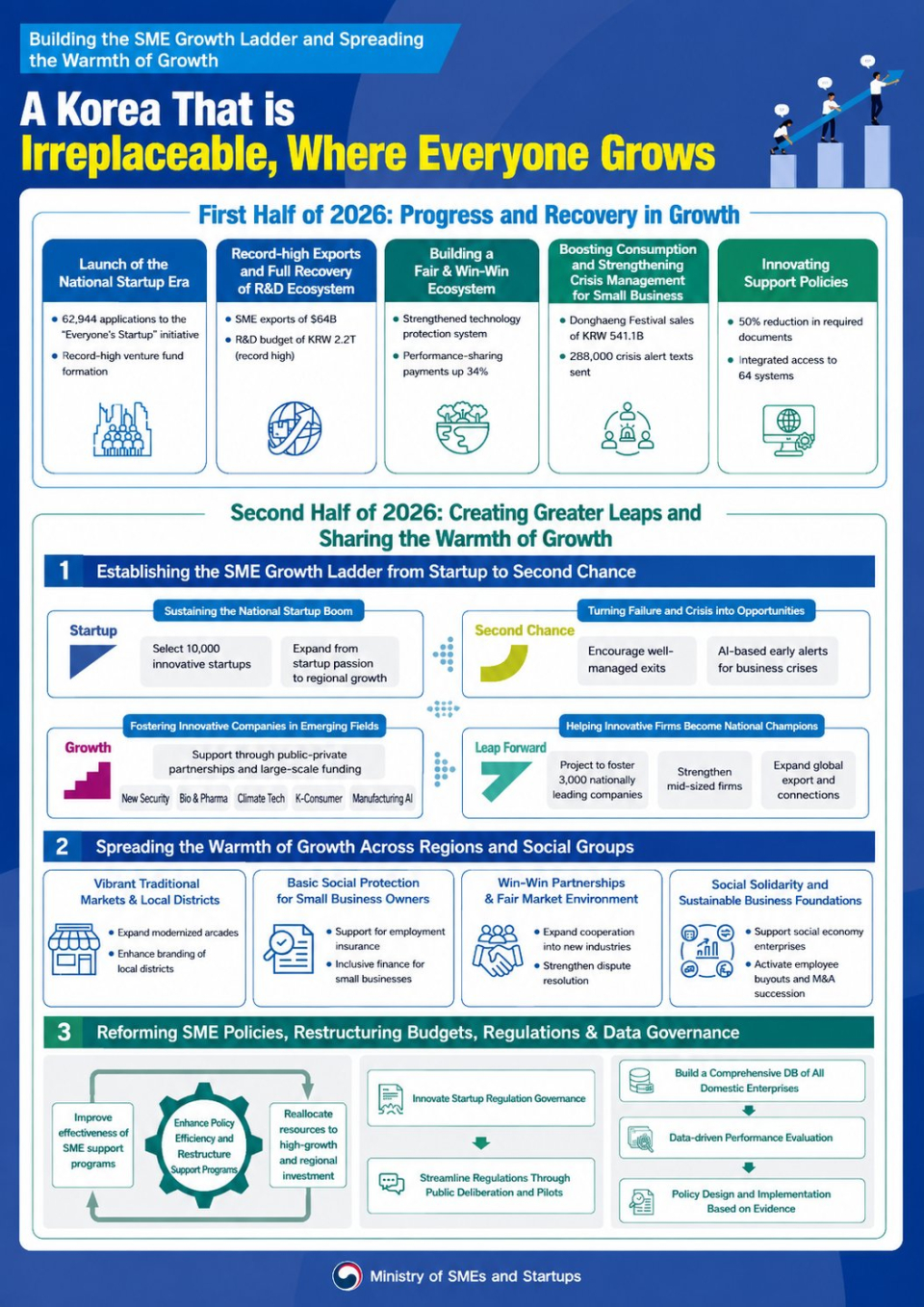
Announced during the ministry's second-half 2026 policy briefing on Aug. 4, the strategy centers on three priorities: building a structured growth pathway for SMEs and startups, extending the benefits of economic growth to regional communities and small businesses, and modernizing the government's SME policy framework.
The initiative marks a shift from fragmented support programs toward a more integrated system that links entrepreneurship, business growth, global market entry and corporate renewal into a single policy framework.
The ministry highlighted strong momentum during the first half of 2026. More than 62,900 people joined the government's nationwide startup initiative, while venture fund formation reached a record KRW 4.4 trillion and venture investment totaled KRW 3.3 trillion. New unicorns emerging in AI and semiconductors also signaled the ecosystem's growing emphasis on deep-tech innovation.
SME exports climbed to a record US$64 billion during the first half of the year, led by continued growth in K-beauty products, while government R&D spending for SMEs reached an all-time high of KRW 2.2 trillion.
Scaling innovative companies for global markets
The ministry plans to expand its nationwide startup program, designate six additional startup cities and establish regional growth funds to strengthen local innovation ecosystems.
It will also introduce long-term support for companies in strategic industries, including AI-powered manufacturing, biotechnology, climate technology, national security technologies and K-consumer products. Selected firms will be eligible for support of up to KRW 40 billion over five years.
To accelerate international growth, the government will strengthen venture financing, expand overseas business hubs, enhance export assistance for SMEs and allow qualifying venture companies to retain key policy incentives after growing beyond their current legal classification. It also aims to foster 3,000 nationally competitive companies through regionally tailored growth programs.
The ministry will also reinforce second-chance entrepreneurship by creating a database of business failures and providing early-warning systems, financial diagnostics and restructuring support for companies facing management difficulties.
Expanding growth beyond technology hubs
Beyond high-growth startups, the strategy seeks to strengthen traditional markets, regional commercial districts and small business competitiveness.
Key measures include modernizing traditional markets, promoting AI-enabled restaurant operations, strengthening local commercial branding and expanding social protection and financial support for small business owners.
The ministry also plans to broaden collaboration between large corporations and SMEs beyond manufacturing into platform businesses, finance and defense industries while improving dispute resolution and fair competition. Additional measures will encourage social enterprises and facilitate business succession through mergers and acquisitions.
To improve policy effectiveness, the government will streamline overlapping SME support programs, introduce a governance framework that reviews the impact of new regulations on startups before implementation, and build a nationwide enterprise database to support evidence-based policymaking.
Acting Minister and First Vice Minister Noh Yong-seok said the ministry's priority for the second half of the year is to strengthen the growth ecosystem for SMEs while ensuring that the benefits of innovation are shared more broadly across society.
For Korea's industrial policy, the significance of the initiative lies less in expanding financial support than in redesigning how innovative companies grow. By connecting entrepreneurship, scale-up, global expansion and business renewal within a single framework, the government is positioning AI and deep-tech industries as long-term engines of national competitiveness.
