



SK Plasma has taken a major step toward expanding Korea's biotechnology footprint overseas by launching a plasma fractionation plant project in Türkiye. The initiative goes beyond conventional pharmaceutical exports, combining technology transfer, infrastructure development, and operational support to establish local production of essential medicines.
SK Plasma announced on June 15 that it held a groundbreaking ceremony for a plasma fractionation facility at the Cubuk industrial site in Ankara, Türkiye.
The project stems from a shareholders' agreement signed in November last year between SK Plasma and the Turkish Red Crescent. Their joint venture, Proturk, will build a production facility covering approximately 36,000 square meters with an annual plasma processing capacity of 600,000 liters.
The facility is expected to manufacture essential plasma-derived medicines, including albumin (ABM), intravenous immunoglobulin (IVIG), and coagulation factor VIII (FVIII). Construction is scheduled for completion in the second half of 2028, with commercial production targeted for 2030.
With a total investment of around €500 million (approximately KRW 900 billion), the project is expected to enhance Türkiye's supply stability for plasma-derived medicines, which have until now relied entirely on imports.
Plasma-derived therapies are designated as essential medicines by the World Health Organization (WHO) and are widely used in treating severe and rare diseases. Countries lacking domestic production capabilities often face supply risks during global disruptions, making local manufacturing a strategic healthcare priority.
As a key shareholder and technology partner in Proturk, SK Plasma will provide core plasma fractionation technologies and support facility construction, quality management, workforce training, and preparations for commercial manufacturing. The company will also participate in the joint venture's management through its 15% equity stake while receiving technology licensing fees.
Before local production begins, SK Plasma plans to process plasma collected in Türkiye at its plant in Andong, South Korea, and supply finished products through a contract manufacturing organization (CMO) arrangement.
The project exemplifies SK Plasma's "self-sufficiency solution" business model, which integrates technology transfer, plant construction, operational support, and equity participation. The model enables partner countries to strengthen healthcare sovereignty while allowing SK Plasma to secure long-term growth opportunities.
The company is also pursuing a "Federation" supply network that links production hubs in Andong, Indonesia, and Türkiye. By expanding global manufacturing sites, SK Plasma aims to improve supply resilience and respond more effectively to regional demand fluctuations and production disruptions.
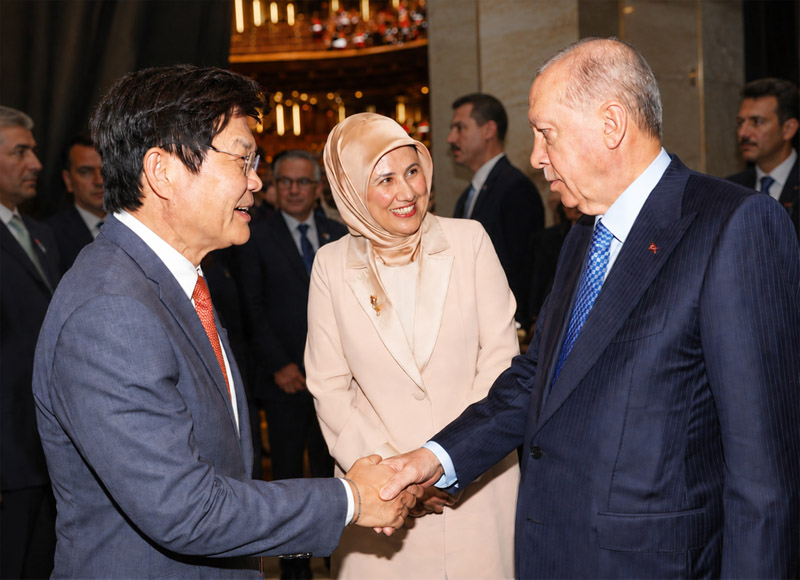
Turkish President Recep Tayyip Erdoğan highlighted the significance of the project during the 158th anniversary event of the Turkish Red Crescent, stating that the plasma fractionation facility would play a crucial role in strengthening Türkiye's essential medicine production capabilities and reducing external dependence.
Kim Seung-joo, CEO of SK Plasma, said, "We have taken the first step toward building a plasma-derived medicine self-sufficiency project under the trust and support of President Erdoğan and the Turkish government."
"Leveraging production hubs in Indonesia and Türkiye, we aim to establish a stable supply system and expand K-Bio's reach into Europe and the Middle East," he added.
Beyond Türkiye, SK Plasma is also advancing plasma fractionation localization projects in Indonesia, further expanding its global healthcare footprint. Industry observers see such initiatives as a new K-Bio growth model that not only generates business opportunities but also improves patient access to treatment and strengthens healthcare security worldwide.
