



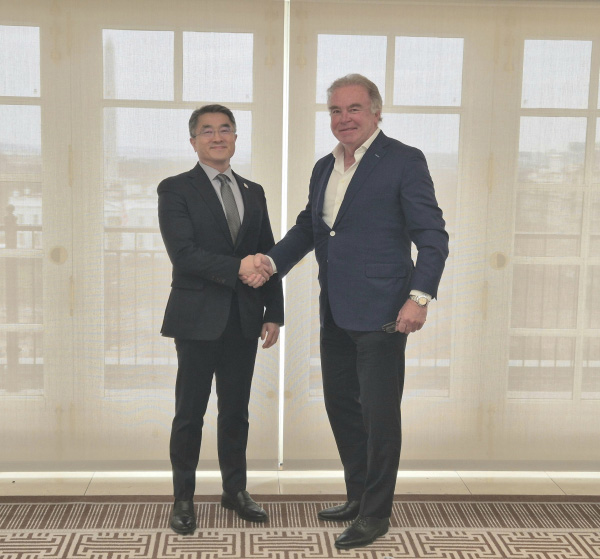
Samsung E&A has officially begun construction of an eco-friendly ammonia production facility in the United States, marking a major milestone in its global energy transition strategy.
On January 5 (local time), Samsung E&A held a groundbreaking ceremony for the U.S. Wabash Low-Carbon Ammonia Project at the Hay-Adams Hotel. The event was attended by around 70 government and project officials, including South Korea’s Minister of Land, Infrastructure and Transport Kim Yoon-duk, Samsung E&A President Namgung Hong, U.S. Deputy Secretary of Energy James P. Danly, and Simon Greenshields, chairman of the board of Wabash Valley Resources.
The project involves the construction of a low-carbon ammonia plant in West Terre Haute, Indiana, with an annual production capacity of 500,000 tons of ammonia and the ability to capture up to 1.67 million tons of carbon dioxide per year. Designed as a next-generation environmentally friendly facility, the plant aims to significantly reduce greenhouse gas emissions while supporting clean energy supply chains.
The project is being carried out as a national-level initiative involving the U.S. Department of Energy as well as South Korea’s Ministry of Land, Infrastructure and Transport and Ministry of Climate, Energy and Environment. In October last year, Samsung E&A signed an engineering, procurement, and fabrication (EPF) contract worth approximately KRW 680 billion (about USD 475 million) with Wabash Valley Resources. Construction is scheduled for completion in 2029.
Samsung E&A plans to leverage its extensive experience in ammonia plant projects along with advanced capabilities such as digital twin technology, artificial intelligence, automation, and modular construction. The company will work closely with the project owner and technology partner Honeywell UOP to ensure efficient project execution.
Beyond this project, Samsung E&A continues to invest in and expand its presence across key energy transition sectors, including ammonia, sustainable aviation fuel (SAF), liquefied natural gas (LNG), carbon capture, and hydrogen. The company has recently secured a series of contracts and design projects, including SAF plants in Malaysia and the United States, a biodegradable plastics plant in the United Arab Emirates, an eco-friendly LNG project in Indonesia, and multiple LNG and SAF front-end engineering design projects in North America.
A Samsung E&A official said the company is pleased to take part in a meaningful project that reflects close cooperation between South Korea and the United States, adding that Samsung E&A will continue to expand new business opportunities in future energy transition fields.
