



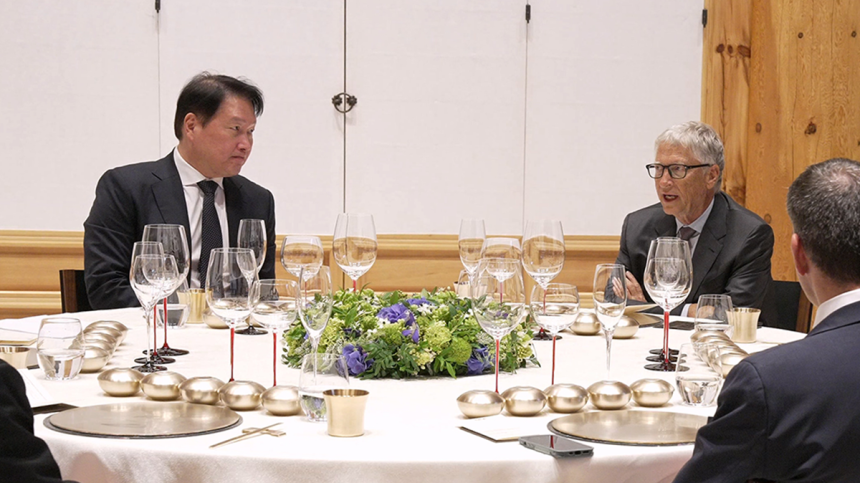
SK Group Chairman Chey Tae-won and Bill Gates, chairman of TerraPower, have met again to discuss ways to secure power for the rapidly growing electricity demand of the artificial intelligence era, signaling that the relationship between SK and TerraPower may be moving beyond a financial investment toward a strategic business partnership.
According to industry sources on Aug. 17, Chey and Gates met for dinner in central Seoul on Aug. 14 to discuss advanced nuclear power, electricity demand from AI data centers and potential cooperation in the global energy market. The meeting came about a year after Gates met Chey during his visit to Korea last August, when the two also discussed small modular reactors (SMRs) and next-generation energy.
The latest meeting coincided with a move to deepen business ties between SK Innovation and TerraPower. The two companies reached a preliminary agreement on key terms for cooperation on global SMR projects, laying the groundwork for SK's participation in TerraPower's projects in the United States and other markets.
SK has already established a strategic position in TerraPower. SK Inc. and SK Innovation jointly invested $250 million in the U.S. nuclear technology company in 2022, becoming its second-largest shareholder.
TerraPower is developing its Natrium reactor project in Wyoming. The project is based on a fourth-generation sodium-cooled fast reactor and incorporates an energy storage system designed to improve the flexibility of nuclear power generation. In March, the project received a construction permit from the U.S. Nuclear Regulatory Commission, marking a major milestone for the commercialization of advanced nuclear technology.
SK Innovation is looking at SMRs as a potential long-term power source for AI data centers, whose electricity consumption is rising rapidly as AI computing expands.
The company already has capabilities in LNG power generation and energy storage systems (ESS). By combining these assets with TerraPower's SMR technology, SK could potentially offer data center operators an integrated power solution covering generation, storage and supply stability.
Under such a model, LNG generation and ESS could provide flexible power during the initial stage of a data center's operation, while SMRs could eventually provide stable, low-carbon baseload power as demand grows.
The strategy fits with SK Innovation's broader shift toward an integrated energy business. Rather than operating solely as a conventional power producer, the company aims to combine multiple generation and storage technologies according to customers' power requirements.
Industry observers say the partnership could become increasingly significant as securing reliable electricity emerges as one of the biggest constraints on AI data center expansion.
“AI data centers require not only large amounts of electricity but also highly stable power supplies,” an industry source said. “A portfolio combining LNG, ESS and SMRs could give SK an opportunity to position itself as an energy solutions provider rather than simply a power generator.”
The partnership, however, is likely to develop in stages. SMRs still face challenges related to construction timelines, economics and regulatory approvals, making LNG and ESS more practical near-term options. SMRs could serve as a longer-term component of SK's power strategy once commercial deployment becomes viable.
The cooperation could also create opportunities for Korean companies across the nuclear supply chain. Korean firms, including Doosan Enerbility, are already participating in the Natrium project, raising the possibility of broader collaboration between SK's energy businesses and Korea's nuclear industry.
With AI driving a structural increase in electricity demand, SK's relationship with TerraPower is increasingly being viewed as a potential platform for building a new energy business around AI data centers—linking advanced nuclear power with existing generation and energy storage capabilities.
