



Subdued consumer confidence and persistently high inflation continued to shape the UK apparel market in 2025, constraining discretionary spending and reinforcing a shift toward value-focused and online channels. The market remained weak through the year, with only limited signs of recovery, as shoppers prioritized convenience, versatility, and lower-priced fashion. Against this backdrop, Shein and Adidas are projected to have recorded the largest market share gains in the UK apparel sector in 2025, according to GlobalData.
Sharon Iles, senior apparel analyst at GlobalData, said brands that combined “strong value perception with trend relevance and clear positioning” were positioned to gain share, while those unable to differentiate or defend price points saw some erosion.
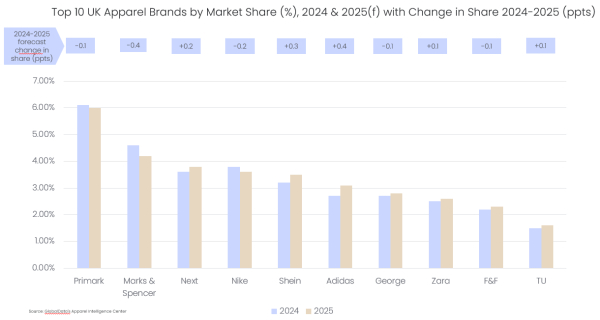
Primark is estimated to have remained the UK’s largest apparel brand, although its market share is expected to have edged down by 0.1 percentage points to 6.0% in 2025. Marks & Spencer is projected to have posted a larger decline of 0.4 percentage points to 4.2%, which GlobalData links in part to disruption from a cyber-attack in early 2025 and intensifying competition in mid-market segments. In sportswear, Nike is forecast to have lost 0.2 percentage points to 3.6%, attributed to a slowdown in innovation and weaker style appeal.
Several brands are projected to have gained share. Next is expected to have increased its share by 0.2 percentage points to 3.8%, supported by its broad product offer and multi-channel presence. Shein is forecast to have lifted its share by 0.3 percentage points to 3.5%, reflecting continued demand for lower-priced, fast-turnaround styles. Adidas is projected to have grown its share by 0.4 percentage points to 3.1%, supported by demand for its Originals range and performance footwear.
Iles said Zara is estimated to have recorded a modest 0.1 percentage point increase to 2.6%, as it maintained style momentum while showing signs of maturation in parts of Europe. Supermarket apparel brands George, F&F and Tu are projected to have each gained 0.1 percentage points to 2.8%, 2.3% and 1.6% respectively, as they improved fashion ranges while keeping prices low—an approach GlobalData said resonated with shoppers during 2025’s economic volatility.
