



AI-powered automation cuts average agent wait time from 47 seconds to five seconds
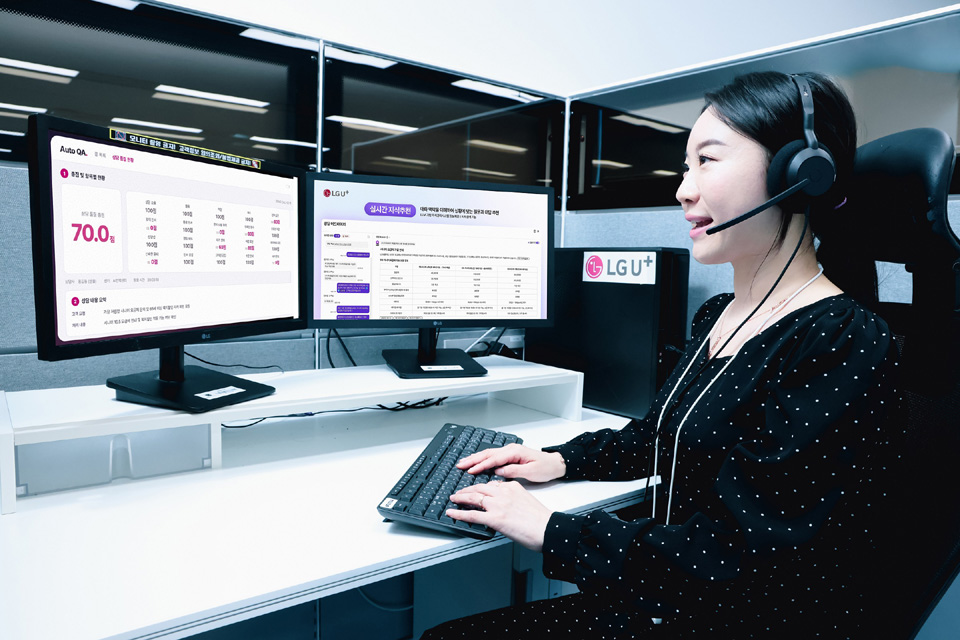
LG Uplus is accelerating its push into the enterprise AI contact center market by combining its own customer service operations with artificial intelligence, aiming to build an “AI-Native Contact Center” with virtually no customer wait times by 2030.
The Korean telecommunications company unveiled its AICC, or AI Contact Center, strategy at a press briefing held at the LG Gasan Digital Center in Seoul on Sept. 30.
LG Uplus is applying AI across the entire customer service process, from AI-powered voicebots and chatbots to its AI Consultation Advisor for human agents and AI Auto QA for automated service quality assessment.
Based on the technology and operational experience accumulated through its own contact centers, the company plans to expand the solutions to enterprise customers and grow its AICC business revenue by more than 50% annually through 2030.
In-House Contact Centers Serve as AI Testbeds
A key element of LG Uplus’ strategy is its in-house approach to AICC development.
The company operates 17 customer service centers nationwide, handling tens of millions of consultations each year. These centers serve as real-world testbeds where new AI technologies can be evaluated using actual customer interactions and operational data before being offered to business customers.
Rather than simply developing and selling AI software, LG Uplus tests its technologies internally, measures customer responses and service quality, and feeds the findings back into product development.
Its customer service specialists can also visit enterprise clients to analyze their operations and design customized AICC systems. Feedback gathered from those deployments is then used to further improve the solutions.
AI is also being incorporated into the development process itself. LG Uplus uses LG AI Research’s EXAONE as well as global AI models to generate consultation scenarios, workflows and AI agents based on a customer’s business objectives and operating guidelines.
The company then tests the systems through simulations designed to resemble real customer service environments before deployment. Once deployed, operational data can be analyzed to identify additional problems and areas for improvement.
AI Handles 8 Million Customer Inquiries Annually
LG Uplus is also dividing customer service tasks between AI and human agents according to the complexity of each inquiry.
Standardized tasks, such as checking mobile plans or subscribing to services, can be handled by AI voicebots and chatbots. About 8 million customer inquiries are currently processed through the company’s AI voicebots and chatbots each year.
Its AI voicebot is designed to understand the context of an entire conversation rather than simply reacting to individual keywords. It can wait when a customer pauses while speaking and use information provided throughout the conversation to determine the customer’s intent.
When a human agent is needed, the AI Consultation Advisor provides real-time assistance.
Conversations between customers and agents are converted into text through speech-to-text technology, allowing AI to analyze the interaction and recommend relevant information, policies and responses.
This reduces the time agents spend searching multiple internal systems and allows them to focus more on customers’ individual circumstances and needs. It can also help less-experienced agents provide more consistent responses.
After each consultation, AI Auto QA analyzes the interaction and identifies individual agents’ strengths and areas for improvement. The system enables a larger share of customer interactions to be assessed under consistent criteria, while allowing service coaches to spend more time on personalized training.
Average Agent Wait Time Falls from 47 Seconds to Five
LG Uplus said the deployment of its in-house AICC has already produced measurable improvements in customer service operations.
The average wait time to connect with a human agent has fallen by about 90%, from 47 seconds in 2024 before the system was introduced to five seconds this year. Average consultation time has also declined by 16% over the same period.
The company is using some of the capacity created by AI automation to strengthen services that require more human attention.
Customers aged 65 and older can receive priority assistance from human agents, while customers with hearing impairments can be connected to sign-language support. LG Uplus also maintains a policy of allowing customers to choose their preferred consultation method rather than requiring them to use AI.
The approach is designed to let AI handle repetitive and standardized processes while human agents concentrate on interactions that require judgment, explanation and personalized support.
Moving Toward an AI-Native Contact Center by 2030
LG Uplus plans to take the model further by shifting from AI-assisted customer service to an operating structure built around AI.
Under its planned AI-Native Contact Center, AI would analyze information such as a customer’s previous consultations and subscription history to better understand the reason for an inquiry and provide relevant information before the customer has to wait for assistance.
The company also plans to analyze customer service data in real time and continuously feed the findings back into the system, creating a cycle in which AI improves as more interactions are processed.
LG Uplus intends to apply the experience gained from its own contact centers to its B2B business, positioning operational expertise alongside AI technology as a key differentiator in the enterprise AICC market.
“In the AI era, competitiveness in AICC depends not simply on the technology itself, but on how quickly customer responses can be translated into service improvements,” said Ahn Hyung-kyun, head of LG Uplus’ Enterprise AI Business Group.
“Based on the experience accumulated through our own customer centers and our in-house capabilities, we will support enterprise customers in their AI transformation and develop AICC into a key growth pillar of our enterprise AX business by 2030,” he said.