



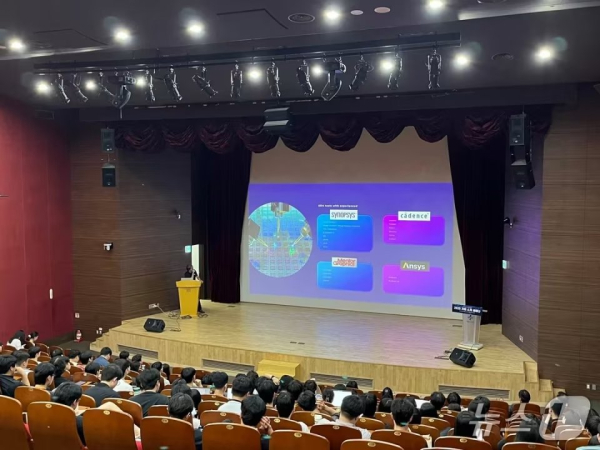
A joint talent development initiative between the Electronics and Telecommunications Research Institute (ETRI) and the Seoul Metropolitan Government has produced measurable results in both youth employment and industrial competitiveness over the past six years. As demand rises for advanced chip design skills driven by the spread of Physical AI—technologies that interact with real-world environments such as robotics, autonomous systems, and smart manufacturing—the program is drawing attention as a practical workforce pipeline.
ETRI’s Metropolitan Area Research Division has operated the AI Semiconductor Design Specialist Training Program since 2020 in partnership with Seoul. Based at the Seoul AI Hub, the program was designed to create a virtuous cycle linking education, employment, and corporate growth, with participation from government-funded research institutes, local government, and industry.
From 2020 through 2025, the program trained a total of 1,769 participants and recorded an average employment rate of 88.3%, according to ETRI. The institute said job placement has increasingly aligned with hiring demand from AI and semiconductor firms in Seoul and the surrounding metropolitan area, helping supply design talent for emerging sectors including Physical AI.
Some companies that hired program graduates have also reported visible business progress. Firms such as OpenEdge Technology, ICTK, and Iron Device have gone public on Korea’s KOSDAQ market, while Supergate and Chips&Media have been recognized as rising fabless semiconductor companies, expanding their presence in the domestic AI chip ecosystem.
The 2025 intake drew 420 applicants, reflecting a competition ratio of about six to one. Selected trainees completed core courses in digital RTL, front-end design, and advanced process-based Auto Place & Route (Auto P&R), areas ETRI described as critical for high-performance, low-power chip design in next-generation AI applications.
Curriculum development is overseen by a committee composed of industry experts, university professors, and ETRI researchers. Participants use professional-grade electronic design automation (EDA) tools and laboratory equipment to complete practical projects. The program also includes mentoring by field specialists, CEO lectures, and job fairs designed to mirror real industrial environments.
According to ETRI, recruitment through job fairs and other placement-linked activities has continued steadily. Evaluations from small and medium-sized enterprises indicate that graduates demonstrate practical skills comparable to employees with six to twelve months of work experience, helping reduce onboarding burdens for employers.
Gwak Jae-hwa, CEO of AI semiconductor design firm AimFuture, said the program’s graduates are able to contribute on-site almost immediately due to their high level of practical preparation. Lee Soo-yeon, Director General of Seoul’s Economic Office, described the initiative as a policy model that addresses youth unemployment while supporting company growth. Lee In-hwan, head of ETRI’s Metropolitan Area Research Division, said the institute will continue working with Seoul to ensure that talent development leads to stronger corporate performance and technological competitiveness.
The training program is part of Seoul’s AI Yangjae Hub Facility Management and Operations Project. The city said it will maintain policy and financial support in 2026 to further develop the AI semiconductor ecosystem and expand youth employment opportunities centered on the Seoul AI Hub.
Recruitment for the 2026 cohort will run from April 1 to May 12 via the SW-SoC Convergence Academy website, with training scheduled from June 22 to August 28.
