



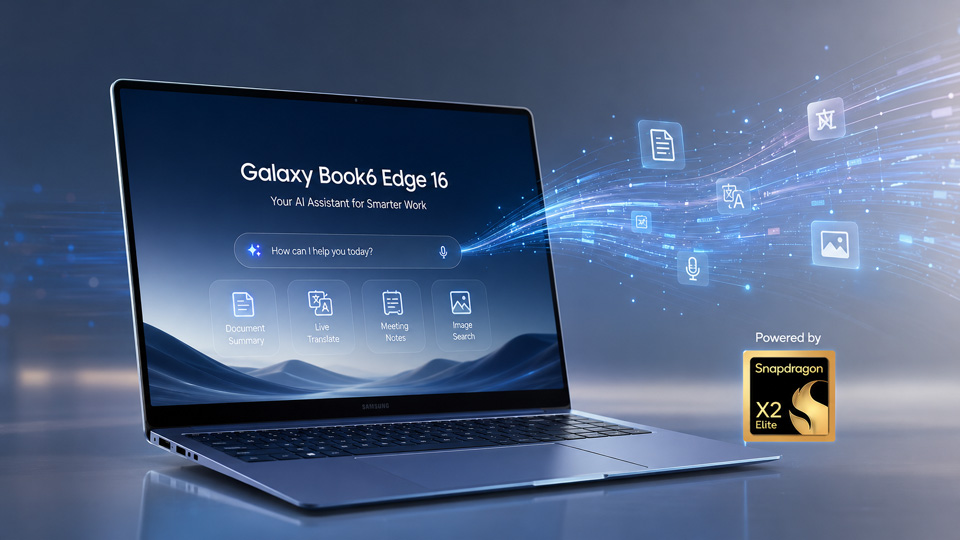
Artificial intelligence is rapidly becoming the new competitive frontier in the PC industry, following its transformative impact on smartphones. As on-device AI technologies gain traction, global technology companies are intensifying efforts to secure leadership in the emerging AI PC market.
Unlike traditional AI services that rely heavily on cloud infrastructure, on-device AI enables data processing and AI inference directly on the device. This shift is expected to redefine the PC market, moving competition beyond conventional performance metrics toward AI processing capabilities and power efficiency.
Samsung Electronics and Qualcomm recently unveiled new AI-powered PCs featuring next-generation AI processors, signaling a broader industry transition rather than a simple product launch. With the global PC market facing prolonged maturity, AI is increasingly viewed as a key driver of future replacement demand and market growth.
Industry observers describe AI PCs as the most significant evolution in personal computing since the smartphone revolution. As generative AI becomes integrated into everyday workflows, users are demanding systems capable of handling document creation, intelligent search, translation, image editing, meeting summarization, and other AI-powered tasks in real time.
As a result, PCs equipped with dedicated Neural Processing Units (NPUs) are widely expected to become the next industry standard.
On-Device AI Reshapes the PC Industry
At the heart of the AI PC movement is on-device AI.
Most generative AI services today rely on cloud-based processing. However, growing concerns over data privacy, network dependency, latency, and operating costs are accelerating the adoption of AI systems that can process workloads directly on local devices.
On-device AI offers several advantages, including faster response times, enhanced privacy protection, and the ability to operate without a constant internet connection. For enterprise customers, these benefits translate into improved security and productivity.
In response, semiconductor companies are increasingly investing in NPUs designed specifically for AI workloads. The performance benchmark for next-generation PCs is gradually shifting from raw CPU speed to AI processing efficiency and power optimization.
Samsung and Qualcomm Expand Mobile AI Into the PC Ecosystem
The partnership between Samsung and Qualcomm reflects a broader effort to extend mobile AI experiences into the PC ecosystem.
Samsung continues to build an interconnected Galaxy AI ecosystem spanning smartphones, tablets, and PCs, while Qualcomm is leveraging its expertise in low-power mobile chip design to strengthen its position in the AI PC market.
Modern AI PC platforms are increasingly focused on delivering both high-performance AI computing and extended battery life. This aligns with the growing demand for mobility and productivity in hybrid and remote work environments.
Industry analysts expect AI experiences that originated on smartphones to expand seamlessly across PCs, tablets, wearables, and other connected devices, creating a unified AI-driven ecosystem.
Competition Intensifies Among Microsoft, Intel, AMD, Apple, and Others
The race for AI PC leadership extends far beyond Samsung and Qualcomm.
Microsoft has launched its Copilot+ PC initiative to accelerate AI adoption across the Windows ecosystem, while Intel and AMD continue to introduce processors with increasingly powerful AI capabilities.
Apple is also strengthening AI features across its custom silicon-powered devices, further intensifying competition in the premium computing segment. Meanwhile, NVIDIA is expanding its influence through AI software platforms and ecosystem development.
As a result, the AI PC market is evolving into a broader ecosystem battle involving hardware manufacturers, semiconductor companies, software developers, and operating system providers.
AI Becomes the New Standard for Personal Computing
Industry experts believe AI capabilities will soon become a primary factor in determining PC competitiveness, surpassing traditional specifications such as processor speed and storage capacity.
If the internet defined the previous era of personal computing, AI is expected to define the next one. Future PCs will increasingly function as personal AI assistants capable of understanding user intent, organizing information, and supporting creative and professional tasks.
“AI PCs are not simply a new category of laptops,” an industry official said. “They represent the beginning of a broader platform transition that will reshape the entire computing experience. Future competitiveness will depend largely on how efficiently and intelligently a device can process AI workloads.”
As AI continues to expand beyond smartphones into every segment of personal computing, competition for leadership in the next generation of computing platforms is expected to intensify. Against this backdrop, the collaboration between Samsung and Qualcomm is widely viewed as a significant milestone in the transition toward an AI-driven computing era.
