



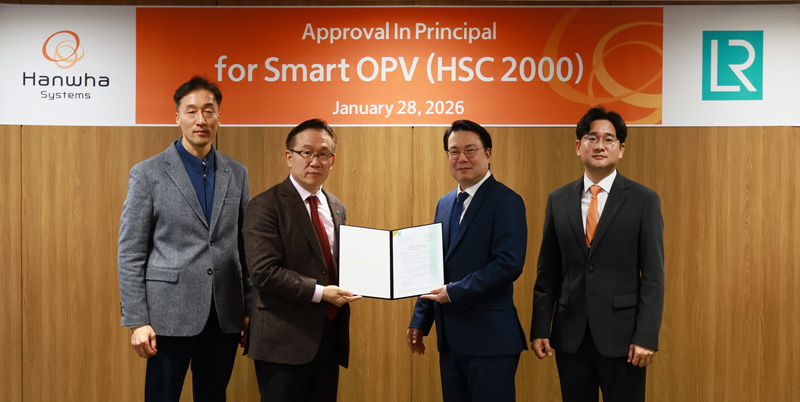
Hanwha Systems said on January 28 that it has obtained Approval in Principle (AIP) from the U.K.-based Lloyd’s Register for its smart multipurpose combat ship concept, marking the first such certification granted to a domestically developed design in South Korea.
Lloyd’s Register is regarded as one of the world’s three major classification societies, alongside ABS and DNV, and applies naval ship rules aligned with NATO standards. Classification certification is widely considered a prerequisite for naval exports, as it verifies compliance with international safety and design requirements.
Concept design represents the highest-level stage in naval ship development, defining mission requirements, key functions, hull form, speed, and weapons configuration. Naval construction programs typically progress from concept design to basic and detailed design, followed by lead ship and series construction.
The newly certified smart multipurpose combat ship is a 2,000-ton-class platform that embodies Hanwha Systems’ “Smart Battleship” concept for future manned naval vessels. The design is centered on AI-based software architecture and is intended to address evolving maritime operational environments.
Hanwha Systems has integrated decades of maritime systems expertise into the platform, incorporating an AI-powered combat management system, an intelligent integrated machinery control system with condition monitoring and fault prediction, a cockpit-style integrated bridge that enables navigation with a minimal crew, a fixed four-face multifunction radar based on AESA technology, unmanned system integration, and stealth-oriented design.
The stealth hull design reduces detectability and enhances survivability, while automation allows the vessel to operate with significantly fewer crew members than conventional manned ships. The company said this could help lower lifecycle costs and address persistent manpower shortages faced by navies worldwide.
Building on the AIP certification, Hanwha Systems plans to develop additional export-oriented naval platforms below the 2,000-ton class and expand its portfolio for overseas markets. By applying Lloyd’s Register standards from the earliest design stage, the company aims to meet future certification requirements of potential customer navies in advance.
Yoo Moon-gi, head of Hanwha Systems’ naval business division, said the smart multipurpose combat ship is designed to improve both operational efficiency and sustainability through AI and automation, adding that the AIP certification positions the company to better address future demand in the global naval market.
