



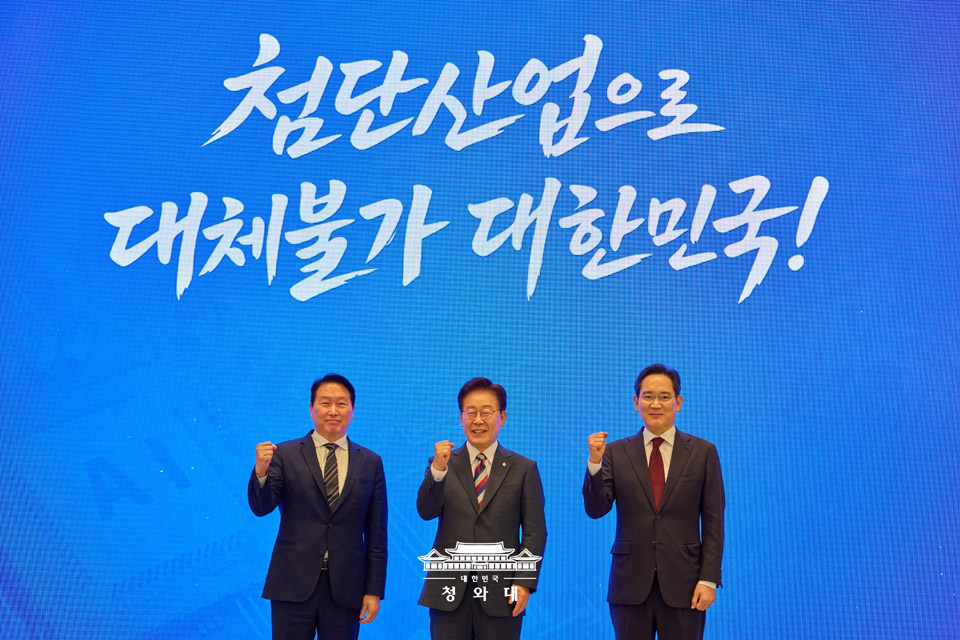
Artificial intelligence (AI) is rapidly reshaping the global industrial landscape, prompting South Korea's two largest technology groups—Samsung and SK—to unveil an unprecedented combined domestic investment plan worth KRW 4,755 trillion. Far beyond expanding manufacturing capacity, the investments are designed to strengthen the nation's long-term competitiveness across semiconductors, AI infrastructure, and advanced manufacturing.
At the "National Mega Project Report on Korea's Next Leap," held at the Blue House on Sunday, Samsung Electronics Executive Chairman Jay Y. Lee and SK Group Chairman Chey Tae-won presented their respective long-term investment roadmaps before President Lee Jae Myung.
The combined investment signals a strategic shift toward building an integrated AI ecosystem rather than simply increasing semiconductor production.
Samsung announced plans to invest KRW 2,655 trillion across semiconductors, displays, next-generation batteries, and AI server package substrates.
The largest portion of the investment will be directed toward semiconductor manufacturing. Samsung will expand its existing semiconductor clusters in Pyeongtaek and Yongin while establishing a new semiconductor cluster in Gwangju featuring two advanced fabrication plants.
The company will also invest heavily in the Chungcheong region, building high-bandwidth memory (HBM) production facilities, advanced AI server packaging lines, and next-generation display manufacturing bases.
The strategy reflects the industry's growing focus on AI infrastructure. As generative AI accelerates demand for high-performance computing, technologies such as HBM and advanced packaging have become critical components for AI servers alongside GPUs.
Samsung also plans to modernize its manufacturing operations by integrating AI-driven automation and Robot Transformation (RX) technologies into production facilities across the Yeongnam region, aiming to enhance productivity and manufacturing competitiveness.
Meanwhile, SK Group unveiled a KRW 2,100 trillion investment strategy centered on semiconductor expansion and AI infrastructure development.
SK hynix plans to invest KRW 1,100 trillion to accelerate construction of its Yongin Semiconductor Cluster, moving the completion schedule for its fourth fabrication plant forward from the original 2045 target to 2033. Additional investments will support new NAND flash production facilities and advanced semiconductor packaging capabilities in Cheongju.
The company also plans to establish a new semiconductor production base in southwestern Korea by constructing two advanced fabrication plants.
A major highlight of SK's announcement was its nationwide AI data center initiative.
Led by SK Telecom, the group plans to build AI data centers with a combined capacity of 15 gigawatts (GW). The first phase will establish 5 GW of capacity, followed by gradual expansion to 15 GW by 2035 in response to growing AI demand.
The project is expected to attract approximately KRW 1,000 trillion in investment through strategic partnerships, customer agreements, and project financing.
The announcements underscore how AI infrastructure has become as strategically important as semiconductor manufacturing itself. As large language models and generative AI applications require enormous computing power and electricity, AI data centers are increasingly viewed as critical national infrastructure.
GS Group also announced plans to invest approximately KRW 30 trillion to build a 2.4 GW AI data center campus in Donghae, Gangwon Province, further highlighting the growing race among Korean conglomerates to expand AI infrastructure.
Industry observers view Sunday's announcements as evidence that competition in the AI era is evolving beyond semiconductor fabrication alone.
Future competitiveness will increasingly depend on an integrated ecosystem that combines advanced chips, HBM, packaging technologies, AI servers, data centers, power infrastructure, and software capabilities.
With the United States and China dramatically increasing investments in AI technologies and semiconductor supply chains, South Korea is seeking to leverage its leadership in memory semiconductors while expanding into broader AI infrastructure.
If successfully implemented, the massive investments announced by Samsung and SK could strengthen South Korea's position not only as a global semiconductor powerhouse but also as one of the world's leading AI infrastructure hubs.
