



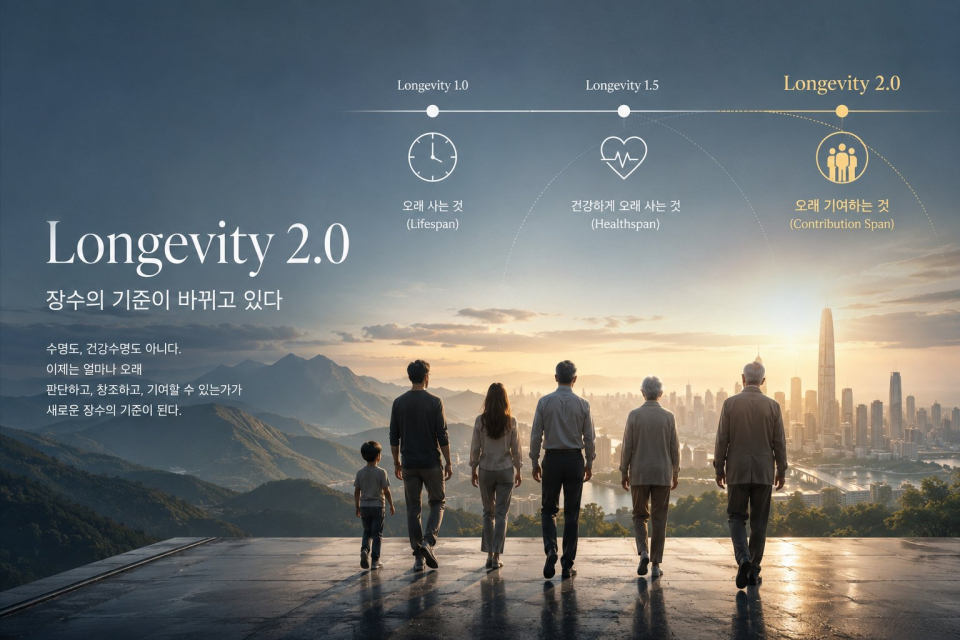
The debate over longevity is moving through three stages. Longevity 1.0 focused on living longer, or lifespan. Longevity 1.5 emphasized living longer in good health, or healthspan. Longevity 2.0 now asks a different question: how long can human beings continue to learn, judge and create social value? This is the idea of contribution span.
Seen from this perspective, the central issue is no longer simply how long people live or how long they remain free from disease. It is how long they can continue to learn, make decisions, create and contribute to others and to society. Longevity 2.0 is not just an extension of survival. It is an extension of human function.
A new concept known as “peakspan” has begun to appear in longevity research. It goes beyond healthspan by asking how long individuals can maintain a level close to their highest physical and cognitive capacity. The idea begins with a simple concern: the absence of disease does not necessarily mean that a person is living at his or her best functional level.
This concept matters because of AI. Artificial intelligence is already taking over parts of human knowledge work, including report writing, translation, coding, data analysis, search and summarization. If human competitiveness remains limited to information processing, its value will inevitably decline.
What AI cannot easily replace is judgment, responsibility, experience-based insight, relationship-building and creative interpretation. Yet these abilities do not exist apart from physical energy, brain health, sleep, mobility and emotional stability. In the AI age, longevity therefore becomes a question of how long the body and brain can sustain high-quality judgment.
The International Monetary Fund has argued in recent analysis on aging economies that healthy aging can increase labor supply and productivity while helping ease the growth pressures caused by population decline. This differs from the older view of aging populations as simply a source of welfare costs. Healthy older adults may increasingly become part of national competitiveness.
The economic meaning of longevity is also changing. In the past, longer lives were often understood mainly through rising medical costs and pension burdens. In Longevity 2.0, healthy older populations are being reassessed as assets that can re-enter the labor market, knowledge industries, education, entrepreneurship and community leadership.
One figure often associated with this shift is Peter Attia. Born in Toronto, he is a Canadian-American physician and author in the field of longevity medicine. He trained at Stanford University School of Medicine and Johns Hopkins Hospital, and is now known for popularizing a preventive approach to longevity medicine from his base in Austin, Texas.
Attia’s emphasis is not simply on how to live longer. In his book Outlive and in his broader medical approach, he argues that people should prepare from midlife to preserve physical function, metabolic health, strength, cardiorespiratory capacity and emotional health in order to avoid spending their final decade in illness and frailty. His concept of the “Centenarian Decathlon” asks what abilities people would want to retain at 100, such as climbing stairs, carrying luggage or lifting a grandchild.
This approach turns longevity into a much more practical issue. The question is not only whether humans can live to 100. It is whether they can still manage their own lives at 100. The issue is not merely whether life can be extended, but whether the body and brain can remain usable for longer.
Here lies the paradox of the AI age. As machines become more intelligent, the value left to humans moves toward more deeply human abilities. But those abilities are not sustained by abstract willpower alone. Muscle, cardiorespiratory fitness, sleep, blood glucose control, brain health and social relationships all become infrastructure supporting human judgment and productivity.
For this reason, Longevity 2.0 is not just the next slogan of the anti-aging industry. It is an economic question about whether aging societies will treat humans as costs or as assets. It is also a civilizational question about how human beings will preserve their value in an age of increasingly capable machines.
For South Korea, this question is no longer distant. The country is entering a super-aged society while facing a shrinking working-age population, rising medical costs, pension pressures and accelerating AI automation. If longevity is treated only as a welfare issue, the costs will grow while the opportunities narrow.
But if the experience, judgment and social contribution of healthy older adults are redesigned, longevity can become a new growth asset rather than a national burden. Future competitiveness will not be determined only by the number of young people. It may also depend on how many people can continue to function, learn and contribute for longer.
For decades, longevity has been understood as the postponement of death. The essence of Longevity 2.0, however, is not simply to delay death but to slow the decline of function. The goal of longevity is not survival alone. It is contribution.
Perhaps the most important task of the AI age is not to extend the human lifespan itself. A new standard is emerging around how long human beings can continue to judge, create, build relationships and generate social value in a deeply human way.
