



Company expands production and R&D footprint in Korea and the U.S.
SK hynix is preparing to extend its leadership in high-bandwidth memory into the next generation of AI memory technologies as artificial intelligence drives fundamental changes across the semiconductor industry.
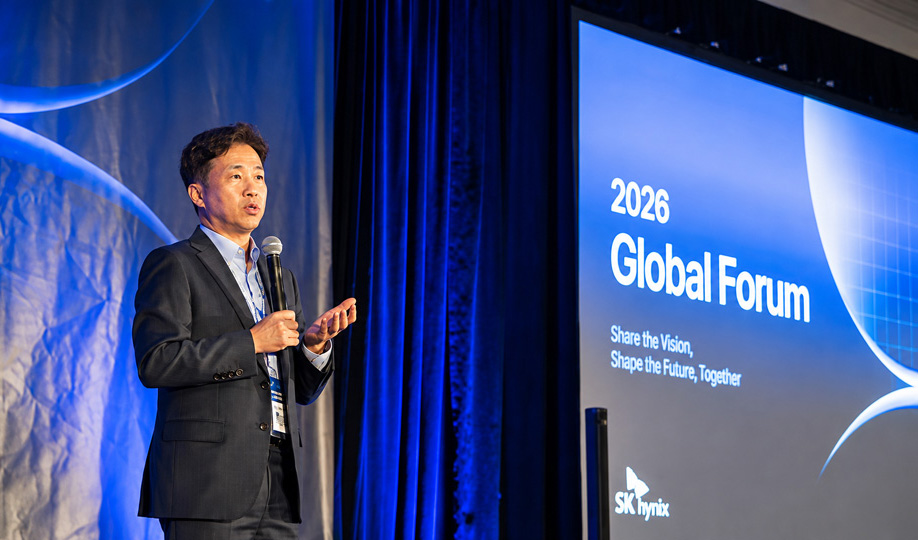
The company said it held its 2026 Global Forum in Santa Clara, California, bringing together AI and semiconductor experts as well as researchers from major U.S. universities to discuss emerging technologies and the future direction of memory.
In a keynote address, SK hynix CEO Kwak Noh-jung said the company intends to build on the technological position it established in HBM and open new opportunities for AI through next-generation memory.
“Just as we established a new milestone with HBM, we will open up new possibilities for AI through next-generation memory,” Kwak said.
He also emphasized the increasingly important role memory plays in the AI industry.
“The AI industry cannot exist without memory,” he said, adding that demand for AI memory is expected to remain strong as the AI market continues to expand.
AI memory competition moves beyond HBM
HBM has become one of the most critical components in AI computing systems as large AI models require rapidly growing amounts of data to move between processors and memory.
The next stage of competition, however, is likely to extend beyond increasing memory bandwidth alone.
As AI accelerators become more powerful, overall system performance increasingly depends on how memory, processors, advanced packaging and system architecture work together. Power efficiency and capacity are also becoming critical as AI infrastructure grows in scale.
That transition was reflected in the theme of this year's Global Forum, “At the Inflection Point of Technology, Opening the Next Chapter of Memory.”
Participants discussed how the semiconductor industry is moving from an era in which individual technologies pursued performance improvements independently toward one that requires closer integration across different areas of the computing system.
The forum included eight roundtable sessions covering four areas: design, process and device technologies, advanced packaging and systems. SK hynix also showcased its HBM portfolio and other core memory technologies.
Production and R&D network expands with AI demand
SK hynix is pairing its technology strategy with an expansion of its global manufacturing and research infrastructure.
In Korea, the company is developing the Yongin Semiconductor Cluster as a major long-term production base. In the United States, it is establishing an advanced packaging facility in Indiana to support growing demand for AI memory.
The company also plans to establish a global AI R&D center in the U.S., strengthening its access to technology partners, research institutions and the broader American AI ecosystem.
Kwak said the company's new global production bases and research infrastructure would help SK hynix maintain its technological competitiveness as the AI memory market evolves.
The strategy reflects a broader shift in the semiconductor industry. As AI systems become increasingly complex, memory suppliers need to work more closely with customers and technology partners across chip design, packaging and system development.
From talent network to AI technology ecosystem
SK hynix has held its Global Forum annually since 2012, traditionally using the event to share its technology vision and connect with semiconductor professionals and researchers overseas.
The forum is increasingly becoming a venue for discussions that extend beyond talent recruitment to the longer-term direction of AI and semiconductor technologies.
This year, the company presented its Yongin cluster, Indiana project and planned U.S. AI R&D center alongside its technology roadmap, illustrating how SK hynix is seeking to connect talent, research and manufacturing through a broader global network.
For SK hynix, the challenge is now to turn its HBM position into a longer-lasting advantage as the AI semiconductor market evolves.
HBM will remain central to AI computing, but competition is expanding into next-generation memory architectures, advanced packaging and system-level optimization. The companies that can connect those technologies effectively are likely to play a larger role in shaping future AI infrastructure.
SK hynix is positioning its expanding production and R&D network around that transition, with the goal of carrying its HBM momentum into the next chapter of AI memory.
