



The race to develop 6G networks is moving beyond faster transmission speeds. A new test by Samsung Electronics and NTT DOCOMO suggests that the next competitive frontier will be networks capable of predicting service degradation for individual users and adjusting resources before problems occur.
Samsung and Japan’s largest mobile operator announced on August 10 that they had successfully validated an artificial intelligence-based radio access network, or AI-RAN, optimization technology. The system analyzes each user’s movement patterns, service behavior and real-time wireless conditions to anticipate declining service quality and automatically select a more suitable network configuration.
Conventional mobile networks generally apply similar settings to smartphones connected to the same cell or base station. This can make it difficult to respond when a user enters a weak-signal area or encounters a sudden change in the wireless environment, resulting in slower video transmission, buffering or dropped connections.
The technology developed by Samsung and NTT DOCOMO narrows the unit of network optimization from the entire cell to the individual user. If the system predicts that the transmission speed of a user streaming high-definition video is about to fall, it can select a more appropriate frequency band or network setting before the disruption becomes noticeable.
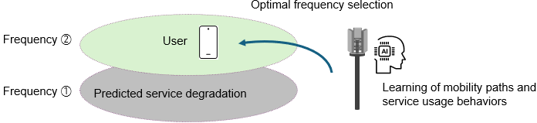
From Cell Performance to Individual Experience
In January, the companies conducted simulations using data collected from NTT DOCOMO’s commercial network and a local 5G trial environment in Japan. The frequency of transmission-speed degradation declined from 13.1% to 7.2%, an improvement of 5.9 percentage points compared with operation without the technology.
The result indicates a broader change in how mobile network performance may be measured. Rather than concentrating primarily on average base-station throughput, operators are beginning to focus on the communication quality experienced by individual users.
Network operations could also become more predictive. Instead of responding after a connection slows or fails, AI-RAN systems are designed to identify early signs of deterioration and adjust wireless resources in advance.
The findings, however, came from simulations based on commercial network data rather than the direct deployment of the technology across a live commercial network. Further testing will be required to determine whether the same improvements can be maintained as user numbers, traffic volumes and wireless conditions change in real time.
Samsung has also tested user-level AI-RAN optimization with KT on a South Korean commercial network involving approximately 18,000 users. By expanding trials with domestic and international operators, Samsung is building a broader base of operational evidence that could support both technology development and future 6G standardization.
AI Models and Network Data Become Part of the 6G Race
If AI-RAN is deployed at scale, competition among telecom equipment companies will no longer depend only on antenna performance, transmission capacity and base-station hardware. The accuracy of AI models, access to real-world network data and the ability to allocate resources in real time could become equally important.
Samsung and NTT DOCOMO also developed a data collection process intended to reduce the additional burden created by AI-based optimization. Instead of collecting and processing large volumes of wireless environment data at once, the procedure selects only the information needed to address the specific problem experienced by a user.
The companies jointly submitted the data collection procedure to the 3rd Generation Partnership Project, or 3GPP, in February. They plan to continue contributing their throughput-degradation prediction and data-processing technologies to international standardization discussions.
JinGuk Jeong, executive vice president and head of the Advanced Communications Research Center at Samsung Research, said the validation demonstrated the potential to improve perceived quality by shifting the research focus from overall cell performance to individual users.
NTT DOCOMO and Samsung plan to advance the technology, explore additional 6G applications and continue their standardization cooperation.
The significance of the test extends beyond the decline in transmission-speed degradation. Mobile networks are beginning to evolve from infrastructure that treats connected devices largely in the same way into systems that learn how individual users move, anticipate what may happen next and adjust their behavior accordingly.
The 6G contest is therefore becoming more than a race to build faster communications equipment. Leadership may depend on which companies can secure the most useful operational data, make the most accurate network predictions and turn those methods into global standards.