



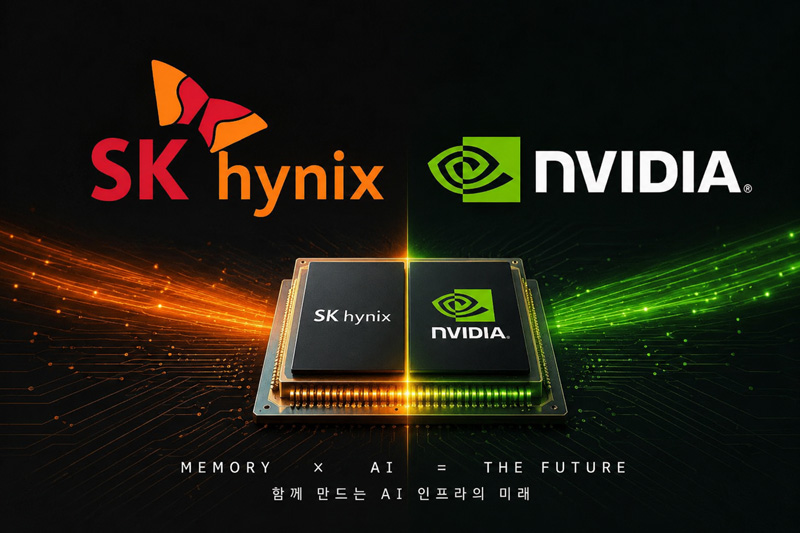
As the global race for artificial intelligence (AI) infrastructure accelerates, SK hynix and NVIDIA are deepening their collaboration to drive the next generation of AI computing. The two companies are expanding their partnership beyond high-bandwidth memory (HBM) to include AI-powered semiconductor development, digital manufacturing, and next-generation AI infrastructure technologies.
SK hynix announced on June 8 that it will strengthen its strategic partnership with NVIDIA to support the emerging era of AI computing. The expanded collaboration encompasses next-generation memory development, AI factory implementation, semiconductor design innovation, and smart manufacturing initiatives.
The two companies have maintained a close relationship through the development and supply of HBM, a critical component for AI servers and accelerated computing systems. With demand for AI infrastructure continuing to surge, the partnership aims to ensure the development and stable supply of advanced memory technologies optimized for future AI platforms.
A key focus of the collaboration is NVIDIA’s vision of the “AI Factory,” a next-generation data center concept designed to train and operate large-scale AI models. AI factories require enormous computing power and ultra-high-performance memory, making advanced memory technologies an essential component of future AI infrastructure.
Looking ahead, SK hynix and NVIDIA plan to jointly develop memory technologies for a broad range of next-generation AI applications, including AI supercomputers, hyperscale data centers, personal AI devices, and robotics platforms. The initiative is expected to help SK hynix expand its presence beyond AI infrastructure into emerging markets such as personal AI and physical AI.
The partnership is also expected to transform semiconductor research and development. SK hynix is leveraging NVIDIA’s GPU acceleration technologies and AI frameworks to enhance simulation performance throughout the semiconductor design process. AI-powered approaches are being applied to technology computer-aided design (TCAD) and computational lithography, enabling faster development cycles and improved design accuracy.
The companies plan to further extend their cooperation into electronic design automation (EDA), creating a new development environment in which AI assists throughout the chip design workflow. Industry observers believe this could foster a new ecosystem that brings together semiconductor manufacturers, AI platform providers, and design software companies.
Manufacturing innovation is another major pillar of the partnership. SK hynix is utilizing NVIDIA’s digital twin technology to create virtual replicas of semiconductor production lines. This enables real-time analysis of manufacturing processes and equipment operations, helping identify optimal production conditions and improve overall efficiency.
AI will also play an increasing role in factory logistics and equipment management. By integrating autonomous mobile robots with production equipment data, the company aims to streamline factory operations and respond more effectively to changes and disruptions in the manufacturing environment.
Furthermore, the two companies plan to connect digital twin environments with AI-driven operational systems, enabling greater automation across production planning, process management, and facility maintenance. Their long-term objective is to build autonomous semiconductor factories where AI continuously analyzes real-time data and supports optimal decision-making.
Industry experts view the expanded partnership as more than a conventional supplier-customer relationship. By combining advanced memory technologies with AI platform capabilities, SK hynix and NVIDIA are positioning themselves to play a leading role in defining the future of AI infrastructure and the broader semiconductor industry.