



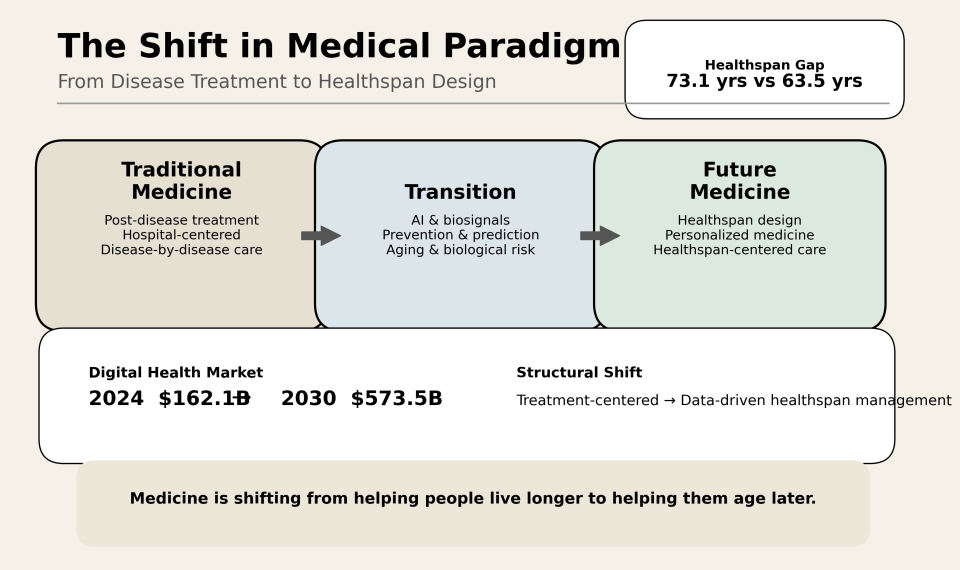
The next route for AI capital is changing. Over the past decade, investment in artificial intelligence has centered on cloud infrastructure, semiconductors, data centers and generative AI models. Now, a growing share of that capital is flowing toward proteins, cells and the biological mechanisms of aging.
This is not simply a story about AI helping drug development. The deeper change is that biology itself is increasingly being treated as a computable system. After learning language and images, AI is now entering the domain of protein structures, cellular aging signals and biological changes that appear before disease becomes visible.
AI Enters the Drug Discovery Value Chain
A clear example is Isomorphic Labs, the AI drug discovery company spun out of Google DeepMind. In May 2026, the company raised $2.1 billion to expand its AI-driven drug discovery engine. According to Reuters, the round included Thrive Capital, GV, Alphabet, CapitalG, Temasek and MGX, while the company is aiming to advance its first programs into clinical trials by the end of 2026.
The significance of the funding lies not only in its size. It suggests that investors are beginning to see AI not as a research assistant, but as design infrastructure for the pharmaceutical industry. Traditional drug discovery has long depended on years of experimentation, high failure rates and heavy clinical costs. AI is now being used to compress several parts of that value chain, from candidate discovery and protein interaction prediction to toxicity assessment and clinical documentation.
The scientific foundation is also advancing. AlphaFold 3 has expanded beyond protein structure prediction to model interactions involving DNA, RNA and small molecules. Nature has described the model as a meaningful step for drug discovery research, while also noting that real-world clinical use still requires experimental validation and regulatory review.
Regulators are responding as well. The U.S. Food and Drug Administration has updated documents and guidance on how AI and machine learning may be used in drug development, regulatory decision-making and manufacturing. This indicates that AI drug discovery is no longer confined to laboratory debate; it is entering the domain of regulation and industrial standards.
From Disease Treatment to Aging Science
The more important development is that this capital flow is extending beyond disease treatment into aging science. The traditional logic of pharmaceuticals was close to “one disease, one therapy.” Cancer, diabetes, Alzheimer’s disease and cardiovascular disorders were treated as separate markets with separate clinical pathways.
Longevity biotech asks a different question. If aging is an upstream biological process behind multiple chronic diseases, then managing the pace of aging and functional decline may become a larger market than treating disease after it appears.
This is where AI and longevity meet. AI is trying to read biological signals before symptoms emerge, while longevity biotech treats aging as a biological system. When the two converge, medicine begins to expand from treatment into prediction, management and redesign.
Retro Biosciences, backed by Sam Altman, illustrates this transition. The company has set a goal of extending healthy human lifespan by 10 years, and Altman is reported to have invested $180 million in the firm. This is not merely a Silicon Valley fascination with longer life. It suggests that AI capital is starting to treat biological aging as a long-term investment category.
Altos Labs belongs to the same context. The company launched in 2022 with about $3 billion in funding and a research focus on cellular rejuvenation programming. Its objective is to approach aging not simply as the passage of time, but as a question of cellular function and resilience.
The issue here is not immortality. The more practical question is whether aging, as a common basis of many diseases, could change both the business model of medicine and the goals of public health. A market that manages biological risk before disease appears could become larger than one that treats individual diseases after the fact.
Building Biological Infrastructure
McKinsey Health Institute has framed healthspan science as biomedical innovation aimed at the processes of aging, linking it to geroscience, precision geriatrics and healthy longevity. McKinsey views improvements in healthspan not only as a medical outcome but also as a social and economic issue.
The economic stakes are considerable. McKinsey has estimated that broader adoption of proven health interventions could add an average of nine years of healthy life by 2050 and generate $12.5 trillion in global economic value. That framing places longevity beyond hospitals and pharmaceutical companies. It connects the field to labor, productivity, insurance, caregiving and pension systems.
For that reason, the longevity economy should not be reduced to expensive clinics or supplements. Its real core is infrastructure: systems that measure biological data, predict health risks, manage the pace of aging and connect those insights to healthcare, insurance, work and personal health management.
A new concept is needed here: biological infrastructure. Previous AI investment cycles built cloud infrastructure, semiconductor capacity and data systems. The next phase of capital may increasingly build platforms that measure, model and manage human biological function.
The Chan Zuckerberg Biohub’s recent release of an AI-based “world model” for protein biology points in the same direction. Reuters reported that the model is designed to help develop stable and effective therapeutic proteins based on protein sequence data, with validation work underway in immune disease and cancer research.
This suggests that AI is moving beyond generating text and images. It is starting to form biological hypotheses, narrow experimental candidates and shift the starting point of therapeutic design. AI is moving from calculating the probability of language to modeling the possibilities of proteins and cellular response.
This trend should not be overstated. Many interventions in aging biology remain in early stages. Cellular reprogramming still carries safety concerns, including cancer risk. Predicting protein structures does not automatically create successful drugs. The distance between candidate discovery and clinical success remains long.
But capital has already begun to price that possibility. Isomorphic Labs’ $2.1 billion raise, Altos Labs’ $3 billion launch, major private backing for Retro Biosciences and the release of AI protein models may look like separate events. In fact, they are connected by a broader movement.
That movement is this: AI is beginning to read the operating system of biology. If past AI reshaped search, advertising, software and content productivity, the next wave of AI capital may try to calculate how the human body ages, when it loses function and under what conditions it maintains resilience.
Seen this way, aging is no longer only a personal fate or a wellness slogan. It is an economic variable that affects healthcare costs, labor supply, productivity, insurance systems and national competitiveness.
The fact that AI capital is turning toward aging should therefore be read differently. It is not simply a repetition of humanity’s old desire to live longer. It is a signal that post-AI capital may be moving from the world of information into the world of biology.
