



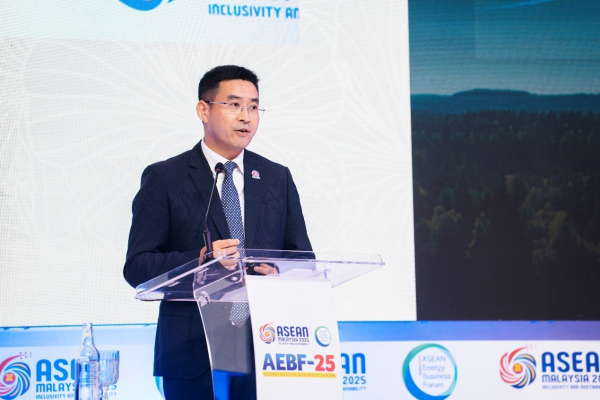
Kuala Lumpur, Malaysia — October 19, 2025: The 25th ASEAN Energy Business Forum (AEBF-25) was held in Kuala Lumpur from October 15 to 17 under the theme “Powering ASEAN: Bridging Boundaries, Building Prosperity.” The forum brought together more than 1,500 participants, including energy ministers from the ten ASEAN member states, policymakers, industry associations, and corporate leaders. Discussions centered on regional energy connectivity, clean energy transition, technology implementation, and investment and finance.
Grid-Forming Technology and Regional Power Integration
Huawei Digital Power Asia-Pacific participated in the forum, introducing its all-scenario solar-plus-storage (PV+ESS) solutions and power stability technologies.
In a keynote speech titled “Enabling the ASEAN Power Grid: The Critical Role of Grid-Forming Technologies for Cross-Border Power Trading,” Xia Hesheng, Vice President of Huawei Digital Power and President of Strategy and Marketing, emphasized that grid interconnection and cross-border renewable power transmission are central to achieving carbon neutrality.
He noted that grid-forming technology plays a vital role in stabilizing power systems with a high share of renewables, marking a transition from traditional “grid-following” to “grid-forming” operations. Huawei’s technology, he said, has been applied in major renewable projects such as The Red Sea development in Saudi Arabia, where it supports 100% renewable microgrid operations, and Cambodia’s first 1GWh grid-forming energy storage project, which received TÜV SÜD certification.
Calls for Regional Standards and Policy Coordination
During a roundtable titled “Strengthening ASEAN Power Grid Resilience: Policy and Investment Strategies for Energy Security and Renewable Integration,” Huawei’s global power grid expert Chen Xieming highlighted the need for unified regional standards to ensure grid security and interoperability. He argued that standardized grid-forming technologies are essential for maintaining grid resilience as the share of renewable energy grows across ASEAN.
Malaysia’s Strategic Role in ASEAN Power Connectivity
Chong Chern Peng, Vice President of Huawei Digital Power Malaysia, participated in the “CEO & Leaders Thoughts” roundtable hosted with the Boston Consulting Group. He described Malaysia’s position as a strategic hub for regional energy interconnection, particularly in cross-border electricity trade with neighboring countries such as Thailand and Singapore.
Chong said that achieving the ASEAN Power Grid vision requires power systems that are both resilient and adaptable, with grid-forming technologies serving as a technical foundation for that transformation. He added that Huawei’s continued investment in PV+ESS and grid-forming systems contributes to building more reliable, low-carbon power networks.
Infrastructure Quality and Long-Term Stability
In the “Ministers and CEOs Dialogue” session, Xia Hesheng said that stable, high-quality energy infrastructure is essential for ASEAN’s energy and economic development. He explained that grid-forming solutions enhance short-circuit capacity, inertia, and black-start capabilities of power systems.
As an example, in The Red Sea project, thousands of power conversion systems operate in off-grid mode and can achieve black start within minutes. Huawei also developed a multi-layered safety protection system for its ESS—from cell to grid level—alongside a “smart string” architecture and strict quality controls. The Golmud project in China’s Qinghai Province, operating for over 13 years with a failure rate below 0.5%, was cited as a case demonstrating long-term system reliability.
Toward a Low-Carbon ASEAN Energy Future
Key themes at AEBF-25 included ASEAN’s ongoing energy mix transition, grid interconnection, and the establishment of common technical standards. Huawei Digital Power said it will continue investing in research and local partnerships to support regional carbon reduction goals.
The company stated that technological innovation—particularly in grid-forming systems—will remain central to achieving a stable, low-carbon, and integrated energy future for ASEAN.
