



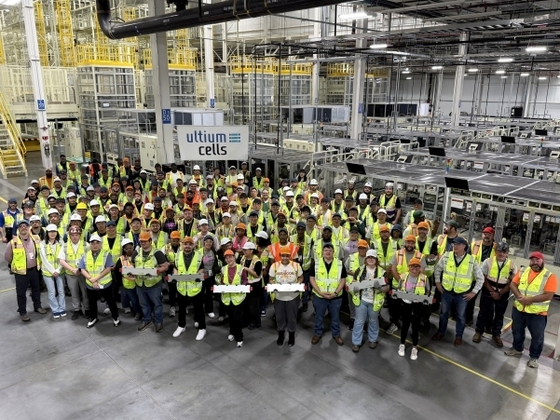
Ultium Cells, the battery joint venture between LG Energy Solution and General Motors (GM), has started mass production of lithium iron phosphate (LFP) battery cells for energy storage systems (ESS) at its Spring Hill, Tennessee facility.
The production launch marks a major step in the companies’ strategy to expand their presence in the rapidly growing North American ESS market. The transition from electric vehicle battery manufacturing to ESS battery production was completed within just a few months, demonstrating the company’s ability to quickly adjust its manufacturing operations in response to shifting market demand.
Ultium Cells announced in March that it would invest approximately $70 million to convert part of its existing production lines in Tennessee for ESS battery manufacturing. The facility has now completed the conversion process and entered commercial-scale production.
The ESS battery cells produced at the Tennessee plant will be supplied to customers through Vertech, LG Energy Solution’s North American ESS system integration subsidiary. The products are designed to meet domestic manufacturing requirements under the U.S. Inflation Reduction Act (IRA), strengthening their competitiveness in the local market.
The batteries are expected to support a wide range of applications, including grid stabilization projects, renewable energy storage systems, and power infrastructure for artificial intelligence data centers. Growing electricity demand from renewable energy expansion and AI-related facilities has accelerated demand for large-scale energy storage solutions across the United States.
Ultium Cells highlighted the rapid conversion of the manufacturing line as a key example of its production flexibility. Employees at the Tennessee facility, who had temporarily reduced operations earlier this year, have also returned to work following the start of ESS battery production.
“By combining LG Energy Solution’s advanced battery technology with the dedication of our Tennessee workforce, we have built a competitive ESS manufacturing system focused on speed, flexibility, safety, quality, and productivity,” said Park In-jae, President of Ultium Cells.
Chris DeSotel, Plant Director at Ultium Cells, said the successful LFP production transition reflects the strong partnership between LG Energy Solution and GM. He added that the company will play an important role in helping customers establish reliable ESS infrastructure for power grids and other strategic applications.
LG Energy Solution is now accelerating the expansion of its North American ESS manufacturing network. The company aims to establish five major ESS production hubs across the region, with facilities already operating in Michigan and Canada, while additional production sites are scheduled to come online.
Once the planned expansions are completed, LG Energy Solution expects to secure more than 50GWh of ESS production capacity in North America by the end of this year.
The company’s growing ESS business is supported by a strong order pipeline. LG Energy Solution has secured supply agreements with major global customers, including Tesla, Teragen, Excelsior Energy Capital, EG4, and Hanwha Q CELLS. In May, the company also signed a separate 6GWh ESS battery supply agreement with DTE Energy for an Oracle AI data center project.
With rising demand for energy storage solutions driven by renewable energy growth and expanding data center infrastructure, LG Energy Solution is positioning ESS as a key growth engine alongside its existing electric vehicle battery business.
