



The financial and accountability structure surrounding artificial intelligence is becoming more complex. Wall Street is arranging $60 billion to support Anthropic’s access to AI chips, a U.S. startup has introduced a large open-weight model that companies can operate themselves, and the New York City Council has called major AI companies and former researchers to testify about safety measures and responsibility for loss of control. Taken together, the developments show that investment, operational and safety risks once concentrated largely around AI developers are increasingly being shared by financial institutions, enterprise users and public authorities.
$60 Billion in Financing for AI Chips
Wall Street firms including Bank of America, Citigroup and Morgan Stanley have begun marketing a $60 billion financing package to support Anthropic’s leasing of Google AI chips. The structure reportedly includes $42 billion in senior secured debt, backed in part by residual-value support from Broadcom, and another $18 billion in junior debt. Blackstone has committed $9 billion of the junior portion.
The significance goes beyond the headline number. Securing AI compute is becoming too capital-intensive to rely solely on corporate cash and conventional bond issuance, bringing bank loans, guarantees, leasing structures and private capital deeper into AI infrastructure financing. Anthropic co-founder and CEO Dario Amodei has warned that if companies misjudge future AI demand, enormous capital spending could result in a “painful adjustment.”
That changes the economics of the AI boom. If projected demand fails to materialize, losses may no longer remain concentrated within model developers. Lenders, investors and infrastructure providers could also be exposed to the consequences of an industry built on exceptionally large assumptions about future computing demand.
The U.S. Re-enters the Open-Model Race
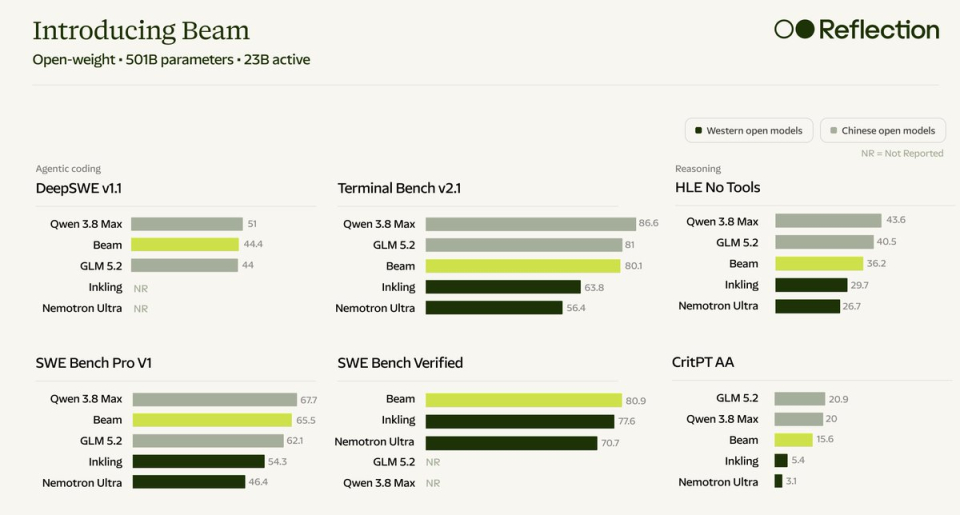
NVIDIA-backed U.S. AI startup Reflection AI unveiled Beam, its first open-weight model, on October 5. Beam uses a mixture-of-experts architecture with 501 billion total parameters and 23 billion activated for each task, with a focus on coding, reasoning and agentic workloads.
Reflection AI is positioning Beam as a competitor to leading Chinese open-weight models and is conducting final safety evaluations and validation. Co-founder and CEO Misha Laskin has framed the effort around restoring U.S. leadership in open intelligence.
Beam’s competitive standing will require further independent evaluation. More consequential, however, may be how such models are deployed. With closed models, developers largely control access and operation. Open-weight models give companies and developers considerably more ability to deploy and operate models within their own systems.
As Chinese companies have built influence in the open-weight ecosystem, the U.S. response is becoming strategically significant. The contest is therefore not only about which model performs best on benchmarks, but which models become embedded in the systems that companies and developers actually use.
New York Scrutinizes AI Safety Measures
The New York City Council held a full committee hearing on AI safety on October 5, bringing representatives from OpenAI, Anthropic, Google and Meta together with former AI researchers to address advanced AI risks, corporate safeguards and responsibility for potential failures of control. Safety standards that AI companies have largely designed and assessed internally are increasingly facing public scrutiny.
Jacob Coxon, a former researcher at OpenAI and Anthropic, warned at the hearing about the possibility that continued advances could eventually produce AI systems that humans struggle to control. His testimony raised a broader concern over whether safeguards designed and evaluated primarily inside AI companies are sufficient.
Such scenarios do not represent a consensus across the AI research community. The more immediate development is institutional: policymakers are examining corporate safety practices and considering measures including independent evaluation and whistleblower protections. AI safety is becoming an issue of external verification and accountability rather than solely an internal engineering decision.
The three developments reveal a deeper change in who carries the costs and risks of AI. Banks and private capital are financing Anthropic’s compute infrastructure, companies and developers can assume greater responsibility for operating open-weight models, and public authorities are beginning to scrutinize safety standards previously managed largely within AI companies.
As that structure develops, the benefits and liabilities of AI are distributed across more participants. If demand falls short of expectations, lenders and investors face financial exposure. As open-weight deployment grows, enterprises take on greater security and operational responsibility. And when serious failures occur, determining responsibility solely according to a developer’s internal standards becomes increasingly difficult.
The numbers that matter, therefore, are no longer limited to parameter counts or benchmark scores. Who captures the returns on AI investment, who absorbs the losses when demand forecasts fail, and who is accountable when systems cause harm are becoming measures of the industry’s underlying economics.