



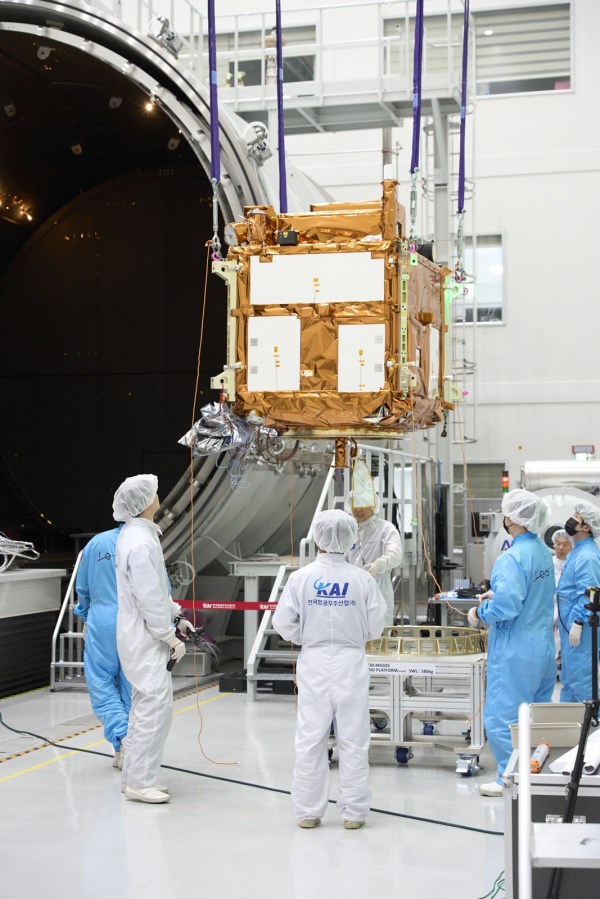
Korea Aerospace Industries (KAI) has completed the initial operations phase of the CAS500-3 satellite and officially transferred operational authority to the National Satellite Operations Center, marking the beginning of the satellite’s full-scale mission activities.
KAI announced on June 1 that it had successfully concluded the early-orbit operation phase of the next-generation medium-sized satellite, CAS500-3, and formally handed over control to the National Satellite Operations Center under the Korea AeroSpace Administration (KASA).
CAS500-3 is a 500-kilogram-class standard satellite developed to support space science research and studies of the space environment. KAI served as the prime contractor for the project. The satellite was launched aboard South Korea’s Nuri launch vehicle in November last year and successfully deployed into orbit.
Following launch, satellites typically undergo an initial operations period to verify onboard systems, payload performance, and overall operational stability before beginning their primary missions. During this phase, KAI continuously monitored the satellite through ground stations in Daejeon and at King Sejong Station in Antarctica, conducting a series of system checks and performance evaluations.
With the completion of the initial operations phase, CAS500-3 will now begin its scientific mission program. The Korea Astronomy and Space Science Institute (KASI) will conduct observations of Earth’s aurora and upper atmosphere, while KAIST will study ionospheric disturbances using data on space plasma and magnetic fields. Hallym University will carry out experiments to validate three-dimensional stem cell differentiation cultures using bio-based 3D printing technology.
KAI has built extensive expertise in satellite development through participation in a range of national space programs, including the Arirang multipurpose satellite series, the Cheollian geostationary satellite program, next-generation medium-sized satellites, and military reconnaissance satellite projects.
Its role in the next-generation medium-sized satellite program has steadily expanded. After participating as a co-design organization for CAS500-1 in 2015, KAI became the program’s prime contractor in 2018 and has since overseen the development and launch of satellites two through five.
The company has also broadened its presence in the small satellite sector. In 2023, KAI signed a contract with the Agency for Defense Development (ADD) to develop a Synthetic Aperture Radar (SAR) demonstration satellite as part of South Korea’s microsatellite program, extending its portfolio beyond medium- and large-scale satellite systems.
Industry observers say the successful completion of CAS500-3’s initial operations represents more than a satellite development milestone. It demonstrates the growing capability of South Korea’s private aerospace sector to independently manage not only satellite manufacturing and launch support but also critical operational phases in orbit, reinforcing KAI’s position as a leading player in the country’s emerging space industry.
