



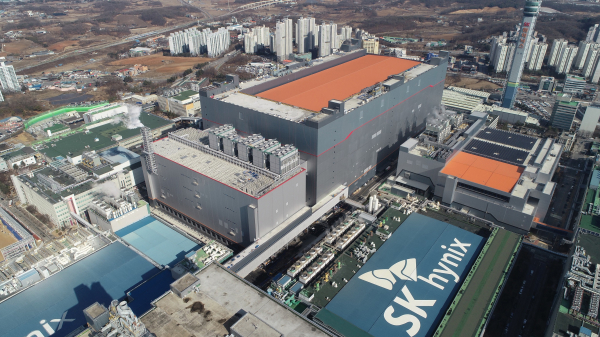
Moody’s has sharply raised its economic growth forecast for South Korea this year to 3.5%, citing stronger-than-expected semiconductor demand and robust export growth. The international credit rating agency also expects the country’s semiconductor boom to continue at least through the middle of next year.
In a report released after completing its regular review of South Korea’s sovereign credit rating, Moody’s forecast GDP growth of 3.5% this year and 2.7% next year. The latest projection is 0.3 percentage points higher than the 3.2% average forecast from eight major investment banks compiled by the Korea Center for International Finance at the end of last month.
The upgrade is particularly notable given how quickly Moody’s has revised its outlook. In February, the agency projected South Korea’s economy would grow just 1.8% this year. It raised the estimate to 2.5% in May before increasing it again to 3.5% only three months later.
The main driver behind the more optimistic outlook is the semiconductor industry. Moody’s said demand for advanced chips remains strong, particularly as artificial intelligence expands, while there are relatively few companies capable of realistically replacing South Korea’s leading high-end memory chip suppliers.
South Korea’s export figures already reflect the strength of the semiconductor cycle. Merchandise exports rose 51% year-on-year during the January-July period, with Moody’s attributing the sharp increase largely to exceptionally strong semiconductor growth.
The agency expects the semiconductor upcycle to remain intact through at least mid-2027. Continued demand for high-performance memory chips used in AI data centers is expected to support exports and corporate investment, providing a broader boost to the Korean economy.
Government-led investment projects could provide an additional source of growth. Moody’s pointed to initiatives targeting semiconductors, AI data centers and physical AI, noting that successful implementation could improve productivity and raise South Korea’s potential growth rate. Efforts to develop new industrial centers outside the Seoul metropolitan area could also contribute to more balanced regional growth.
Improved growth prospects are also expected to ease near-term fiscal pressures. Moody’s forecasts South Korea’s fiscal deficit at 3.8% of GDP this year, 0.1 percentage point better than the government’s original target, supported by higher-than-expected tax revenues and stronger economic growth.
However, Moody’s warned that South Korea still faces significant long-term fiscal challenges. Rapid population aging is expected to increase mandatory spending, while defense and national security costs and investment needed to maintain export competitiveness could add further pressure to government finances.
The latest forecast therefore offers both an upgrade and a warning. South Korea’s economy is benefiting from a powerful semiconductor cycle driven by AI demand, but sustaining growth beyond the current boom will require new engines of expansion.
The key challenge will be turning the current semiconductor momentum into broader industrial competitiveness. Developing AI and advanced manufacturing while addressing demographic and fiscal pressures will be crucial if South Korea is to maintain stronger growth after the semiconductor cycle eventually cools.
