



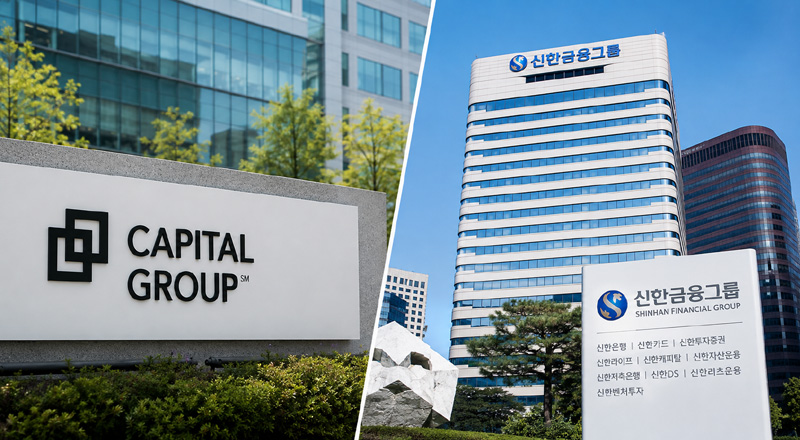
Capital Group, one of the world's largest asset managers, has raised its stake in Shinhan Financial Group above 5%, drawing attention to how global long-term investors are reassessing Korean financial stocks amid stronger profitability, capital efficiency and shareholder return policies.
According to a regulatory filing, Capital Group held 23,568,346 shares of Shinhan Financial Group as of Aug. 26, representing a 5.02% stake. Its ownership crossed the 5% disclosure threshold after it purchased an additional 115,260 shares.
Capital Group disclosed the purpose of the holding as a "simple investment."
The U.S.-based investment manager, which had more than $3.6 trillion in assets under management as of the end of June, is known for its long-term, active investment approach. It had previously held more than 5% of Shinhan Financial before reducing its position, making its return above the threshold notable at a time when the Korean financial group is accelerating its corporate value-up strategy.
The Bigger Question Is Why the Stake Rose Again
The significance of the disclosure extends beyond the 5.02% figure itself.
Capital Group's increased ownership comes as Shinhan's earnings, capital efficiency and shareholder return policies are increasingly moving in the same direction.
Shinhan has pursued a corporate value enhancement plan built around key indicators including return on equity, or ROE, a common equity tier 1 ratio above 13% and a total shareholder return ratio of at least 50%.
The group's strategy is also evolving beyond simply increasing dividends and share buybacks.
Its focus is increasingly on improving profitability and capital efficiency to create a sustainable foundation for shareholder returns. The basic formula is to generate higher returns from existing capital and then allocate those earnings between future growth and shareholder distributions.
Shinhan Financial has said Capital Group's increased stake could reflect positive assessments of its efforts to create sustainable shareholder value under its Value-Up 2.0 strategy, along with improving ROE supported by stronger performances at non-bank affiliates.
From Shareholder Returns to Capital Allocation
Shinhan's value-up strategy has entered a new phase.
The group had initially targeted an ROE of at least 10%, a total shareholder return ratio of 50% or higher and a reduction of more than 50 million shares by 2027.
After making faster-than-expected progress toward those goals, Shinhan unveiled "Value-Up 2.0" this year, shifting its focus toward a more flexible capital policy linking profitability, growth and shareholder returns.
The change reflects a broader challenge facing financial groups.
Higher dividends and aggressive share buybacks can support valuations, but sustainable shareholder returns ultimately require sufficient earnings growth. Excessive capital distributions can also constrain investments needed to generate future profits.
For financial institutions, the next stage of the value-up competition therefore increasingly comes down to capital allocation: not only how much capital is returned to shareholders, but where the remaining capital is deployed to generate higher returns.
That is the balance Shinhan is seeking between profitability, growth, capital efficiency and shareholder returns.
Non-Bank Recovery Adds Another Piece to the Valuation Story
Changes in Shinhan's earnings structure are supporting that strategy.
Shinhan Financial reported net income of 3.443 trillion won ($2.5 billion) for the first half of 2026, up 13.3% from a year earlier and the highest first-half profit in its history.
While the banking business continues to provide a stable earnings base, improving performances across non-bank businesses, including securities, are helping diversify the group's sources of profit.
That matters for financial holding companies because heavy dependence on banking can leave earnings more exposed to changes in interest rates, margins and loan growth.
Stronger securities, insurance, asset management and wealth management operations can diversify revenue while providing additional opportunities to improve group-wide capital efficiency.
This helps explain why Shinhan is putting greater emphasis on ROE and non-bank competitiveness rather than pursuing balance-sheet expansion alone.
What Are Global Investors Looking for in Korean Financial Stocks?
Capital Group's purchase should not be interpreted as direct confirmation that Shinhan's Value-Up 2.0 strategy alone drove its investment decision. The regulatory filing identifies the purpose of its stake simply as an investment.
Still, the timing is noteworthy.
Korean financial stocks have historically traded at relatively low price-to-book valuations despite their substantial earnings, making the sector one of the most visible examples of the so-called "Korea discount."
That valuation equation has begun to change as major Korean financial groups strengthen capital policies around ROE and CET1 ratios while increasing dividends and share cancellations.
For global investors, the question is consequently moving beyond which financial group generates the largest absolute profit.
The more important distinction may increasingly be which institution can deploy capital efficiently, generate sustainable returns and balance investment for future growth with distributions to shareholders.
That is also the central question behind Shinhan's Value-Up 2.0 strategy.
Capital Group's return above the 5% ownership threshold is one market signal worth watching as Shinhan seeks to translate stronger earnings and capital efficiency into a broader reassessment of its corporate value.
