



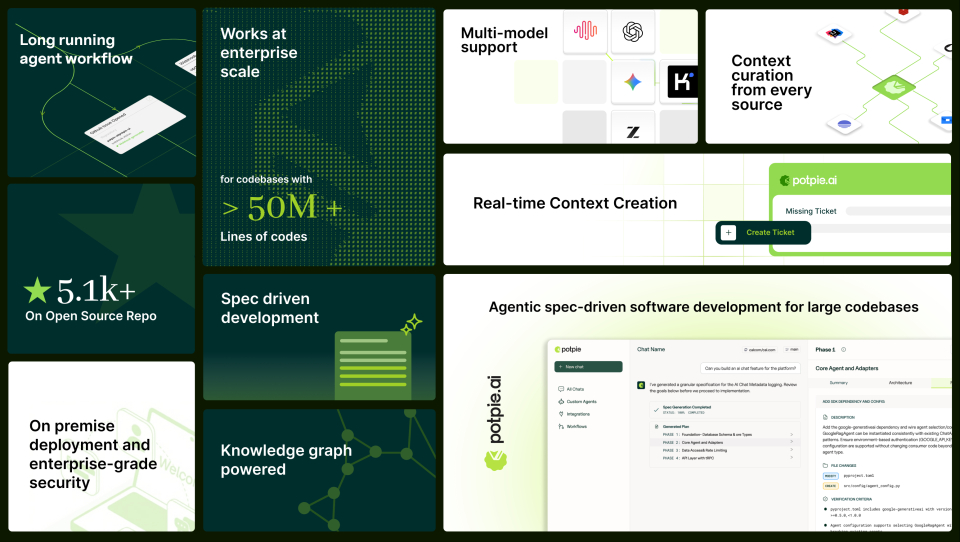
San Francisco — February 23, 2026 — Potpie AI said it raised $2.2 million in a pre-seed financing round to develop what it describes as a foundational “context layer” aimed at helping AI agents operate within large, production software environments. The company said the round was led by Emergent Ventures, with participation from All In Capital, DeVC, and Point One Capital.
Potpie said it will use the funding to support early enterprise deployments, expand its engineering team, and continue building its core context and agent infrastructure. The company positions its product as infrastructure for teams running large-scale codebases where system knowledge is distributed across tools and documentation—and often concentrated among a small number of senior engineers.
Focus on context beyond code generation
Potpie argues that many generative AI tools emphasize code generation while under-addressing the challenge of context in real-world engineering systems. The company said large language models can be effective at producing code snippets, but struggle in production environments without access to system-level understanding, architectural intent, tooling history, operational signals, and the relationships between services and components.
To address that, Potpie said its platform aggregates and links information across an engineering stack, including source code, tickets, logs, documentation, and code reviews. It then structures that information so AI agents can use it more reliably when planning and executing tasks.
Spec-driven workflow as “source of truth”
Potpie said its approach centers on spec-driven development, where a written specification becomes the primary reference point for implementation. Under this model, the company said agents first translate requirements into an implementation plan, map dependencies and edge cases, and align tests and rollout steps before code is written. Potpie’s stated premise is that agent performance depends on both the quality of information an agent can access and the set of tools it can use safely.
Aditi Kothari, CEO and co-founder, said the company is targeting the shift from code generation to system-level reasoning in complex software environments. Potpie described its platform as “ontology-first,” indicating a focus on structured representations of software concepts and relationships as the basis for agent behavior.
Targeting large and complex codebases
Potpie said it is designed for enterprise environments with codebases starting at roughly one million lines of code and scaling to hundreds of millions. Rather than acting as another coding assistant, the company said its platform builds a graphical representation of a software system, infers patterns across modules, and produces structured artifacts intended to help agents operate consistently and within defined constraints.
The company listed example use cases across the software development lifecycle, including debugging cross-service failures, maintaining and writing end-to-end tests, blast radius detection, and system design tasks.
Potpie also said it updates context as systems evolve. The company said it can automatically update documentation and tickets when pull requests are created and can generate system design artifacts when tickets are opened. It also said it creates structured behavior definitions for agents so they follow codebase-specific operating rules. In addition, Potpie said it maintains a searchable, tagged index across APIs, services, databases, and components to narrow the search space and improve reliability.
Company background and reported early results
Potpie was founded by Aditi Kothari and Dhiren Mathur. The founders said they began working on the problem in October 2023 during the early wave of generative AI adoption, focusing on developer workflows rather than general knowledge work. Potpie said it spent close to two years building the underlying layer that models codebases and creates a knowledge graph, and it publicly launched in January 2025.
In describing early deployments, Potpie cited examples of reported performance improvements. One customer with a codebase exceeding 40 million lines of code reduced root-cause analysis time for production issues from nearly a week to about 30 minutes, the company said, with engineers shifting from primary investigators to reviewers. Another customer with legacy systems used the platform to update and generate tests, compressing work the company said previously took multiple sprints into a shorter cycle.
Anupam Rastogi, managing partner at Emergent Ventures, said enterprises face a primary challenge not in generating code but in understanding systems well enough to change them safely. He said Potpie’s “ontology-first” approach and spec-driven workflow create a structured model that enables agents to reason across services, dependencies, tickets, and production signals.
Adoption claims and open-source footprint
Potpie said it is working with Fortune 500 and publicly listed companies in regulated industries, including healthcare and insurtech. The company also said its open-source projects have surpassed 5,000 stars on GitHub, which it described as supporting enterprise adoption.
Kothari said the company’s focus is on “AI readiness” as a systems capability rather than model selection, and that Potpie aims to become a foundational layer for building and operating complex software with AI integrated from the outset.
