



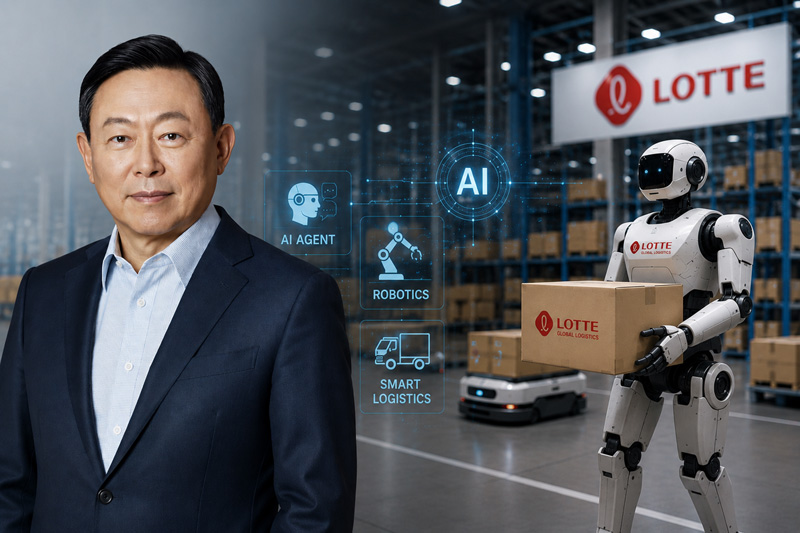
Lotte Group is accelerating its enterprise-wide artificial intelligence (AI) transformation, positioning AI as a core pillar of future competitiveness. From executive mindset shifts and employee training to workflow innovation and new business development, the conglomerate is advancing a comprehensive AI-driven overhaul across its operations.
According to industry sources on June 16, Lotte recently launched an intensive AI education program for CEOs of its affiliates as part of its effort to establish an AI-centered management framework. The initiative reflects the group’s strategy to go beyond digital transformation and embed AI-driven decision-making and operational innovation throughout the organization.
The program was attended by around 50 CEOs from major affiliates and featured hands-on training focused on practical applications rather than theoretical understanding. Participants reportedly experienced “vibe coding,” a method of creating software using natural language prompts, and took part in building AI agents.
Shin Dong-bin, Chairman of Lotte Group, also visited the training session and personally participated in AI-based service development exercises, demonstrating the group’s strong commitment to AI transformation. Following the training, executives reviewed AI transition strategies and discussed implementation priorities for their respective affiliates.
Lotte views AI not merely as a productivity tool but as a key growth engine for securing future competitiveness. The group plans to expand AI agent training programs to all employees within the year, enabling them to develop practical skills that can be immediately applied in their daily work.
The company aims to restructure workflows so that repetitive and standardized tasks are handled by AI, allowing employees to focus on high-value activities such as planning, strategy development, and customer value creation. Lotte expects this approach to improve both productivity and decision-making speed.
Industry observers say Lotte’s latest move signals a new phase in the AI race among South Korea’s major conglomerates. Companies are increasingly moving beyond generative AI adoption and redesigning organizational culture and business processes around AI.
Beginning next month, Lotte plans to introduce external generative AI services to broaden employees’ access to AI tools. The group also intends to host AI hackathons and AI challenges to identify best practices and share innovation outcomes among affiliates.
Changes are also expected in recruitment and talent evaluation systems. AI literacy and digital capabilities are likely to become key assessment criteria, reshaping hiring standards to better align with an AI-driven business environment.
Lotte is also actively expanding into AI-powered new businesses. Its IT affiliate, Lotte Innovate, is developing physical AI solutions that combine generative AI with robotics technologies. The company is pursuing humanoid robot development for industrial applications, aiming to commercialize general-purpose robotic services.
Meanwhile, logistics affiliate Lotte Global Logistics is collaborating with robotics companies and academic researchers to evaluate the feasibility of deploying bipedal AI humanoid robots in logistics environments. The initiative is expected to contribute to logistics automation, improved operational efficiency, and the development of future smart logistics systems.
“If digital transformation in the past was primarily about building systems, we are now entering an era where AI fundamentally changes how organizations operate,” an industry official said. “Cases like Lotte’s, where top executives are directly involved, can significantly accelerate AI adoption across organizations.”
Another industry source noted that widespread use of AI agents could dramatically improve productivity and processing speed, adding that Lotte’s diverse business portfolio spanning retail, logistics, and services could amplify the benefits of AI transformation.
“AI transformation is no longer optional but essential for corporate survival,” Chairman Shin said. “We will actively support all employees in developing AI capabilities and adopting new ways of working.”
