



Company to develop cloud-independent collaborative robots and AI-powered welding solutions for advanced manufacturing
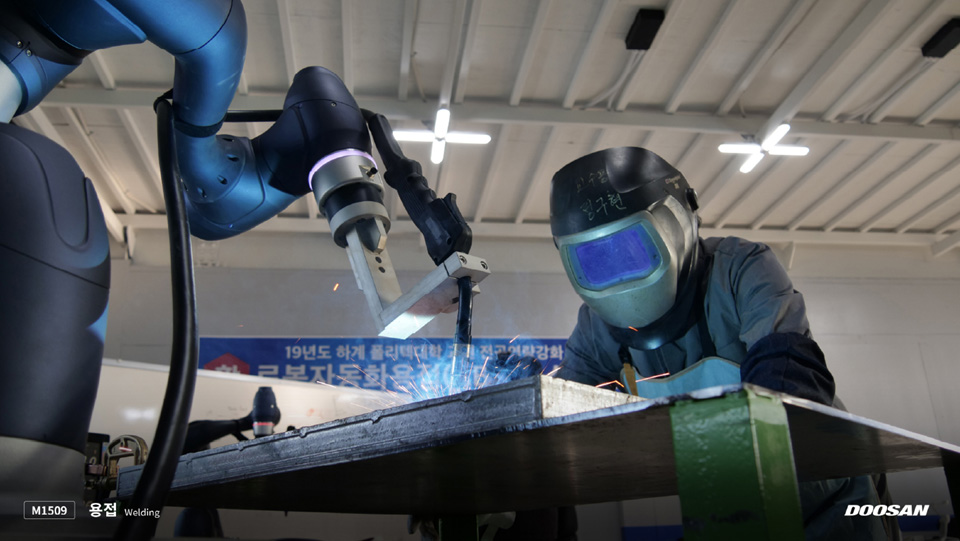
Doosan Robotics is stepping up efforts to develop intelligent collaborative robots powered by homegrown AI semiconductors, aiming to bring physical AI into advanced manufacturing environments ranging from nuclear power to defense and biotechnology.
The company said on Oct. 6 that two of its proposals have been selected for government-backed research projects led by the Ministry of Trade, Industry and Energy and the Korea Planning & Evaluation Institute of Industrial Technology.
The projects cover the development of next-generation collaborative robots based on on-device AI semiconductors and an intelligent welding solution combining collaborative robots with artificial intelligence.
Their combined research and development budget is approximately 98.9 billion won ($70 million), including about 68.1 billion won in government funding.
Doosan Robotics plans to use the first project to develop core technologies that enhance robots’ perception, decision-making and control capabilities, while the second will apply AI-powered robotics to complex manufacturing processes.
The company ultimately aims to integrate the technologies into what it calls a “Korean physical AI collaborative robot platform.”
Collaborative Robots Designed to Think Without the Cloud
The first project focuses on developing next-generation collaborative robots capable of perceiving their surroundings, making decisions and controlling their movements without relying on external PCs or cloud computing.
The project will integrate an AI neural processing unit, or NPU, and real-time communication and control functions into a Korean-developed AI system-on-chip, or SoC, for use in collaborative robots.
Using data from cameras, tactile sensors, force and torque sensors, and voice inputs, the robots will be designed to process information and make decisions directly at industrial sites.
Doosan Robotics plans to develop three collaborative robot models with payload capacities of 5 kilograms, 10 kilograms and 20 kilograms. It will also develop an industrial humanoid capable of dual-arm operation and omnidirectional movement.
The robots will undergo 72-hour continuous-operation demonstrations at two or more customer sites as well as international safety certification. Doosan Robotics aims to commercialize them as standard products beginning in 2031.
On-device processing could also broaden the use of collaborative robots in security-sensitive industries such as nuclear power, defense and biotechnology, where concerns over communication latency or transferring industrial data to external cloud systems can limit automation.
The 54-month project will be led by Doosan Robotics, with participation from Aidin Robotics, Mobilint, the Korea Electronics Technology Institute, the Korea Institute of Industrial Technology, SAIGE and industry-academic cooperation groups from several Korean universities.
AI to Learn Skilled Workers’ Welding Techniques
The second project focuses on developing an intelligent welding solution combining collaborative robots, AI and digital twin technology.
The system is designed to use cameras to recognize welding targets and automatically adjust the robot’s working position. AI will also learn from the movements of skilled welders to generate welding paths and weaving motions, in which a welding torch moves from side to side to achieve consistent weld width and quality.
Doosan Robotics aims to achieve more than 95% alignment between robot-generated welding paths and those of skilled workers, while limiting path deviation to within ±3 millimeters under testing by an accredited national institution.
The company also plans to automate multilayer welding of five or more layers and reduce working time by more than 50%.
Testing will take place at Doosan Enerbility’s Nuclear Power Center. The technology will initially be applied to processes such as tack welding, preheating and welding in the production of nuclear power equipment.
After securing the necessary nuclear quality certifications, Doosan Robotics plans to expand the technology into shipbuilding, industrial plants and defense manufacturing.
The project will run for 45 months, with Doosan Robotics serving as the lead organization. DEEPX, SAIGE and Changwon National University’s industry-academic cooperation foundation will participate as research partners, while Doosan Enerbility will participate as an end-user company.
Integrating AI Chips, Software and Robotics
The two projects are intended to integrate AI semiconductors, software and robotic hardware into a physical AI platform built around domestic technologies.
Rather than limiting robots to predefined repetitive tasks, Doosan Robotics is seeking to develop systems capable of perceiving changes in their surroundings, making decisions and reproducing complex skills traditionally dependent on experienced workers.
“Labor shortages and the aging of skilled workers in manufacturing are structural challenges that cannot be addressed simply by increasing the number of automated systems,” said Park In-won, CEO of Doosan Robotics.
“By combining on-device AI semiconductors with our collaborative robot platform, we aim to develop physical AI collaborative robots capable of learning and reproducing even the tacit knowledge of skilled workers and turn them into a new source of competitiveness for Korean manufacturing.”
