



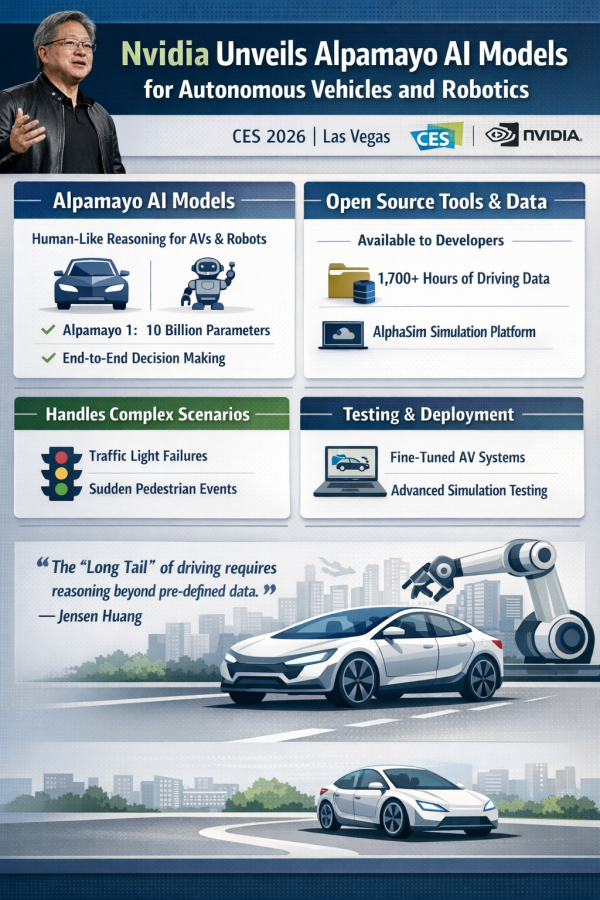
At CES 2026 in Las Vegas, Nvidia introduced a new family of open AI models, datasets, and simulation tools aimed at accelerating the development of autonomous vehicles and physical robots.
Speaking during a keynote on January 5, Nvidia chief executive Jensen Huang described the company’s new “Alpamayo” models as a step toward human-like reasoning in machine decision-making. He said the technology is designed not only for self-driving cars but also for training and operating robots in real-world environments.
Unlike conventional driving models that rely on predefined scenarios, Alpamayo is trained end to end—from raw camera input to vehicle control outputs such as steering, braking, and acceleration. According to Huang, the system does more than execute commands; it evaluates situations and reasons through potential actions before acting.
Rather than running directly inside vehicles, the Alpamayo models are positioned as large-scale “teacher” systems. Developers can adapt and fine-tune them to form the backbone of their own autonomous driving stacks, tailoring smaller models for real-time deployment.
At the center of the release is Alpamayo 1, a 10-billion-parameter vision-language-action model built on a chain-of-thought architecture. Nvidia says this approach allows vehicles to handle rare or unexpected traffic situations—such as malfunctioning signals or sudden pedestrian movement—even when those scenarios were not explicitly encountered during training.
Huang emphasized that this capability addresses what engineers call the “long tail” of driving: the vast number of unusual edge cases that cannot be exhaustively captured through real-world data collection alone. By breaking complex events into familiar components, he argued, autonomous systems can respond more reliably.
To support developers, Nvidia has made Alpamayo’s core code and datasets publicly available via Hugging Face. The company is also releasing an open driving dataset comprising more than 1,700 hours of footage from diverse regions and conditions, with a focus on rare and complex scenarios. Developers can use the models to build tools such as reasoning-based evaluators and automated video labeling systems.
In parallel, Nvidia unveiled AlphaSim, an open-source, end-to-end simulation platform hosted on GitHub. The framework enables closed-loop testing with realistic sensor models, configurable traffic behavior, and scalable virtual environments for validating autonomous driving systems.
Looking ahead, Huang said he expects autonomous vehicles to account for a significant share of global car fleets within the next decade. He added that the same combination of synthetic data generation, reasoning models, and simulation will be foundational not just for cars, but for a wide range of robotic systems.
