



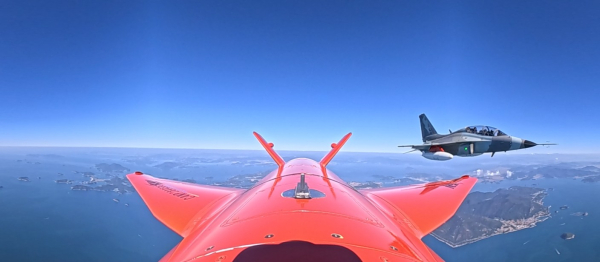
KAI’s FA-50 and AAP drone conduct a close formation flight off Goheung, South Jeolla Province, on October 8. / Video courtesy of KAI
Korea Aerospace Industries (KAI) said it successfully conducted its first formation flight between an FA-50 and its Adaptable Aerial Platform (AAP) drone over Goheung, South Jeolla Province, on October 8.
The FA-50 and AAP flew in formation for 20 minutes at approximately 7,000 feet, or 2.1 kilometers, above the sea south of Goheung, maintaining a separation of 30 to 100 feet, or approximately 9 to 30 meters. The flight was conducted at 360 kilometers per hour, taking flight stability and operational feasibility into account, with the two aircraft maintaining steady spacing. The AAP is capable of reaching a maximum speed of 790 kilometers per hour, and KAI plans to gradually expand its flight speed and operating envelope.
AAP Trials Advance Autonomous Flight with KAiLOT
The AAP is a 150-kilogram-class high-speed drone that KAI has been developing through its own investment since 2024. Powered by a jet engine, it measures 3.1 meters in length and has a wingspan of 2.2 meters. It has undergone continuing flight tests since its maiden flight in October 2025. KAI is now refining its autonomous flight technology through flight demonstrations incorporating its AI pilot, KAiLOT.
The AAP is intended to fly alongside manned fighters and other drones within a next-generation manned-unmanned teaming (MUM-T) system, carrying out missions including reconnaissance, jamming, deception and strikes. Such a system could strengthen the operational capabilities of manned aircraft by performing missions in high-risk areas that are difficult for manned fighters to undertake directly.
FA-50 Mission-Control Trials to Support Unmanned Combat Aircraft Development
KAI plans to use data gathered during the flight to advance multi-aircraft formation demonstrations involving AI pilot-based MUM-T systems. In particular, it plans to demonstrate an FA-50 controlling the AAP’s missions while flying alongside it, further developing MUM-T technology and securing capabilities needed for its future MUCCA unmanned combat aircraft.
“This formation flight is significant because it marks the first time in Korea that actual flight operations involving a manned aircraft and a drone have demonstrated the operational potential of manned-unmanned teaming,” said KAI President and CEO Kim Jong-chul. “We will continue developing relevant technologies so that the capabilities accumulated through proactive investment by a domestic defense company can contribute to the development of future air power.”