



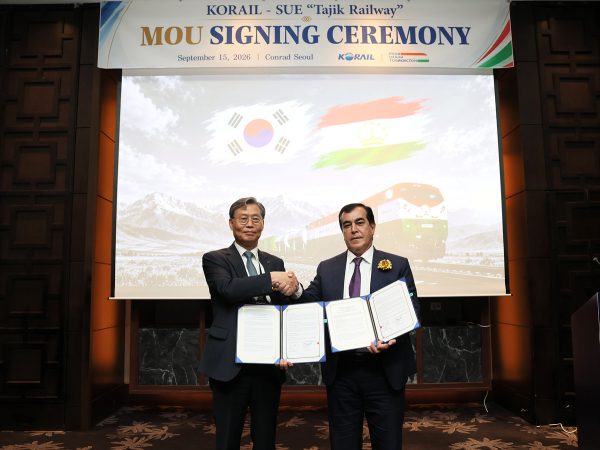
KORAIL is stepping up efforts to enter Tajikistan’s railway market, building on its work on a proposed urban rail system in the capital Dushanbe.
KORAIL said Tuesday that it signed a memorandum of understanding with Tajik Railway during the 2026 Global Infrastructure Cooperation Conference, or GICC, held in Seoul. The agreement is aimed at expanding cooperation between the two railway operators and creating a foundation for follow-up projects related to the Dushanbe urban rail project.
The agreement follows KORAIL’s participation in a preliminary feasibility study for the proposed railway system. The Korean operator carried out the study from 2025 through July this year while also holding discussions with senior transportation officials and Tajik Railway.
The Dushanbe urban rail project is being pursued by Tajikistan to ease traffic congestion, improve public transportation and strengthen the competitiveness of the capital. KORAIL’s latest agreement could provide an opportunity to move its involvement beyond the feasibility-study stage and into subsequent phases of the project.
Under the MOU, the two sides will explore cooperation in a range of areas, including the construction of the Dushanbe urban railway, railway workforce development, operations and maintenance, technical exchanges, maintenance technologies and information technology.
For KORAIL, participation in the project’s basic and detailed design phases will be a key priority. The company plans to continue discussions with Tajik Railway as it seeks to establish a stronger foothold in Tajikistan’s railway modernization efforts.
The partnership will also focus on developing local railway expertise. Tajik Railway plans to establish a training center for railway professionals and is considering technical consulting cooperation with KORAIL as part of the project.
The workforce-development initiative could become an important component of the broader partnership, allowing KORAIL to share its experience in railway operations and maintenance while helping Tajikistan build the technical capabilities needed to operate and maintain modern rail infrastructure.
The agreement also reflects KORAIL’s broader efforts to expand its overseas business. Railway projects typically require expertise across multiple stages, including planning, design, construction, operations, maintenance and workforce training. Securing an early role in infrastructure development can therefore create opportunities for longer-term cooperation.
Central Asia is also emerging as an area of interest for railway infrastructure development as countries across the region seek to modernize transportation networks. KORAIL’s experience in Dushanbe could potentially serve as a foundation for pursuing additional railway projects in the region.
Kim Tae-seung, president of KORAIL, said the agreement was significant because it formalizes the trust built through cooperation on the Dushanbe project.
“We will actively support the modernization of Tajikistan’s railway system while expanding our presence in the Central Asian railway market,” Kim said.
KORAIL plans to work with Tajik Railway on specific cooperation projects, including follow-up work on the Dushanbe urban rail system and programs designed to strengthen local railway capabilities.
