



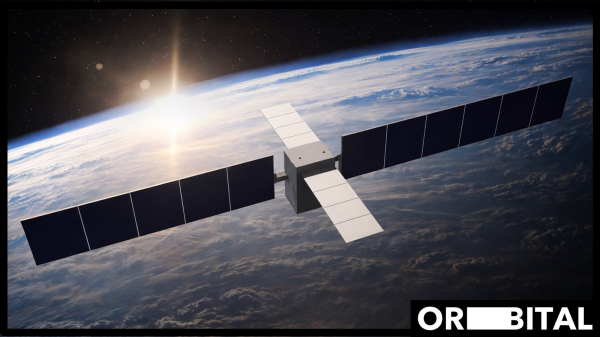
Demand for artificial intelligence compute is rising sharply, and Orbital said in Los Angeles, California, on April 14 that the main bottleneck is no longer chip supply, but the power needed to run and cool large-scale AI infrastructure. The company, which is developing AI data centers for low Earth orbit, says future compute expansion may require shifting away from competition for energy resources on Earth and generating power directly in space.
Orbital is building space-based AI infrastructure designed to operate using solar power and radiative cooling, with the aim of addressing the energy and thermal constraints that increasingly limit terrestrial data centers. The company said it has received backing from a16z Speedrun to support Orbital-1, its first test mission, and is also opening Factory-1, a research and development facility in Los Angeles.
According to the company, it is designing and manufacturing a constellation of satellites in low Earth orbit, each equipped with a cluster of NVIDIA-powered servers. These satellites would be powered by solar arrays and cooled by radiating heat directly into space. Orbital says that in sun-synchronous orbit, solar power is available continuously and at greater intensity, without interruption from weather, nighttime, or dependence on the terrestrial power grid.
Andrew Chen, General Partner at a16z Speedrun, said the firm backed Orbital because it is addressing what he described as one of AI’s most difficult infrastructure constraints. He said the company is pursuing an ambitious approach to a problem that is becoming increasingly central to the next phase of AI development.
Orbital says its infrastructure strategy is built around a distinction between AI training and AI inference. Training large models typically requires thousands of GPUs to be tightly connected with near-zero latency, a configuration the company says is not well-suited to satellite-based systems. Inference, by contrast, can be distributed more easily across independent nodes because each request can be processed separately. Orbital is therefore focusing on inference workloads, where compute capacity can scale across a satellite constellation and serve requests in parallel.
The company’s first satellite, Orbital-1, is scheduled to launch on a SpaceX Falcon 9 in April 2027. The mission is intended to validate sustained GPU operation in orbit, test radiation-hardening capabilities, and, following validation, support commercial AI inference workloads in space. Orbital also said it is in the process of filing with the US Federal Communications Commission to deploy a broader satellite constellation for orbital AI compute infrastructure.

Euwyn Poon, Orbital’s founder and chief executive, said electricity and cooling are becoming the defining constraints in data center economics. He said orbital infrastructure offers a different operating environment, with continuous solar availability and a cooling model that differs fundamentally from terrestrial systems.
Orbital was founded by Poon, a Cornell-educated engineer and lawyer who previously founded Spin, the micromobility company later acquired by Ford. At Spin, he oversaw the deployment of hundreds of thousands of small electric vehicles across 100 cities and helped scale the company to more than $100 million in revenue. After leaving the company, Poon began investing in AI infrastructure and concluded that energy constraints would become a material obstacle to further advances in artificial intelligence.
He said the energy ceiling facing AI is no longer theoretical, but an emerging real-world limit on the pace of progress. Orbital says space-based compute infrastructure could provide a scalable and long-term solution to this emerging constraint.
