



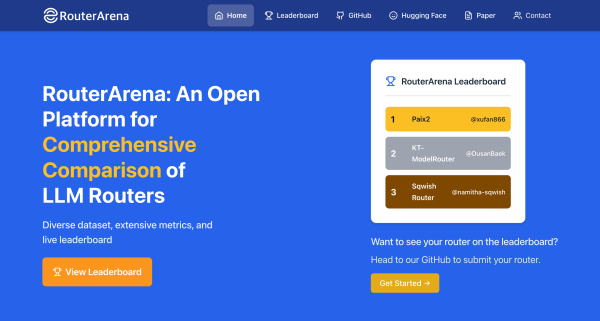
KT said its proprietary AI model routing technology, AutoModelRouter, ranked second in the Acc-Cost Arena of RouterArena, a global benchmark for evaluating large language model (LLM) routers.
RouterArena was developed by researchers at Rice University in the United States. The research was accepted as a regular paper at ICLR 2026, an international machine learning conference. The platform evaluates AI routers using about 8,400 queries, measuring response accuracy, cost efficiency and robustness to changes in input.
KT’s technology is listed on the RouterArena public leaderboard as “KT-ModelRouter.” It ranked No. 2 in the Acc-Cost Arena, which evaluates both response quality and cost efficiency. The leaderboard includes technologies developed by academic researchers as well as commercial solutions such as Microsoft’s Azure Model Router.
The result highlights KT’s efforts to strengthen its AI orchestration capabilities as enterprises increasingly adopt multiple AI models. Rather than relying on a single model for all tasks, companies are adopting multi-model environments because each AI model has different strengths, performance levels and pricing.
For example, relatively simple tasks such as translation or information searches can be handled by cost-efficient models, while complex analysis and advanced reasoning may require higher-performance models.
AutoModelRouter analyzes a user’s request based on factors including task type, difficulty and knowledge domain. It then selects an appropriate AI model by considering the quality and cost of each model.
The system does not simply select the highest-performing or cheapest model. Instead, it is designed to meet the required quality level while improving cost efficiency. A lower-cost model can be assigned to simple translation or information-checking tasks, while a high-performance model can handle complex document analysis or advanced reasoning.
From the user’s perspective, the process takes place within a single AI service. Behind the scenes, however, different AI models can be deployed depending on the characteristics of each request.
The technology could become increasingly important as companies expand the use of generative AI across business operations. As AI usage grows, companies also face rising token costs, making efficient allocation of AI models an important part of managing enterprise AI spending.
Model routing can also reduce the burden on companies of comparing newly released AI models based on performance, pricing and suitability for different applications. A flexible routing system allows companies to add or replace models while managing performance and costs across a multi-model environment.
KT is applying AutoModelRouter to the model-routing capabilities of its Token Factory platform. Token Factory integrates various AI models and token usage environments, while AutoModelRouter automatically selects the model best suited to each user request.
KT plans to further enhance AutoModelRouter and build a flexible multi-model environment that can incorporate new AI models. The company aims to help enterprise customers optimize AI operations according to their required quality levels, workloads and budgets.
