



Applications close at 10 a.m. on September 14, with successful candidates joining in January 2027
Hyundai Card and Hyundai Commercial have opened their 2026 graduate recruitment program, adopting a unified selection process that allows successful candidates to choose their specific roles after joining the companies.
Rather than recruiting separately for predetermined positions, the two financial companies will evaluate applicants through a common process and assign them after they have gained a fuller understanding of the available functions. The approach is intended to match new employees with roles based on their interests, strengths and understanding of the work, instead of relying solely on choices made before entering the organization.
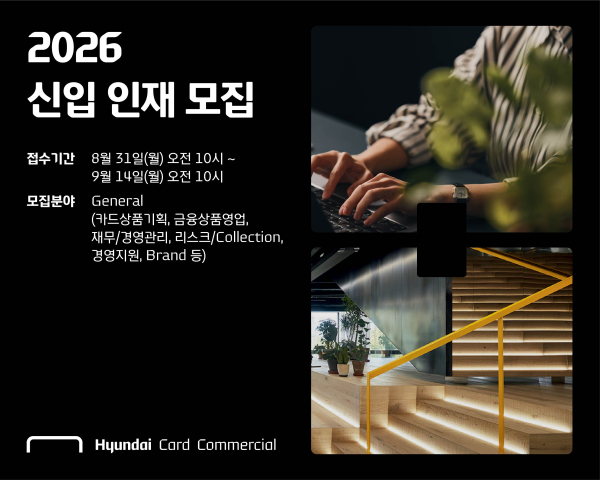
Applications will be accepted through the Hyundai Card and Hyundai Commercial recruitment website until 10 a.m. on September 14. Graduates of Korean and overseas universities, as well as students expected to graduate by February 2027, are eligible to apply regardless of their academic major.
The selection process consists of an application review, a written examination and two rounds of interviews. Successful candidates are scheduled to join the companies in January 2027. The companies have not disclosed the number of positions available.
Unified recruitment followed by role selection
New employees may ultimately work in card product planning, financial product sales, finance and business management, risk and collections, corporate support or brand operations. These areas span the design and distribution of financial products, credit-risk assessment, receivables management, finance, human resources and brand strategy.
The defining feature of the program is that applicants do not have to commit to a detailed role at the application stage. The companies will first assess candidates’ broader capabilities and then provide opportunities to examine individual departments before making final placement decisions.
Hyundai Card and Hyundai Commercial operate a “Job Selling” program in which employees introduce the responsibilities, working methods and skills required in their departments. A separate “Job Fair” gives new recruits an opportunity to consult department representatives about specific positions and potential career paths.
The programs allow employees to compare different functions using information drawn from day-to-day operations. For the companies, the process provides an additional basis for assessing job fit that may not be visible from academic backgrounds, application documents or interviews alone.
Recruitment reflects broader boundaries in financial work
Although Hyundai Card and Hyundai Commercial recruit jointly, their principal businesses differ. Hyundai Card operates across payments, card products, customer data, marketing and brand management, while Hyundai Commercial has expanded from commercial-vehicle and industrial finance into corporate and investment finance.
Hyundai Card has increasingly applied data science and artificial intelligence to product development, customer analysis, personalized benefits and risk management. Its data science-based hyper-personalization platform, UNIVERSE, has also been supplied to Sumitomo Mitsui Card Company in Japan. More recently, the company introduced services using AI agents to interpret individual spending patterns and present customers with personalized insights.
Hyundai Commercial, meanwhile, has been diversifying its asset portfolio beyond industrial finance. Its financial assets exceeded 10 trillion won in the first half of 2025, including approximately 3.8 trillion won in corporate finance and 1.24 trillion won in investment finance. This expansion has increased the importance of capabilities in corporate analysis, credit assessment, structured finance and portfolio management.
The unified recruitment model reflects the increasingly interconnected nature of these operations. Card product planning now requires an understanding of customer data and risk, while corporate and investment finance increasingly depends on digital tools, sector knowledge and the ability to work across conventional organizational boundaries.
It is also notable that AI and data are not presented as standalone recruitment categories. Their inclusion across product planning, sales, risk, finance and brand functions suggests that digital competence is increasingly treated as a basic capability throughout the organization, rather than the exclusive responsibility of a dedicated technology unit.
Through unified selection and post-entry career exploration, Hyundai Card and Hyundai Commercial aim to reduce the pressure on applicants to make an early occupational choice and improve the alignment between employees and departments. The model places greater weight on what new recruits learn about the organization after joining—and on their ability to apply knowledge across financial, commercial and digital functions.
