



KT is seeking to make artificial intelligence a built-in feature of everyday platforms rather than a standalone service requiring specialist knowledge. By connecting widely used consumer services with domestic AI models, chips, cloud infrastructure and networks, the company aims to let people experience AI within the digital services they already use.
KT said on August 26 that it would work with companies and institutions including Musinsa, Zigbang, Daum, the Educational Broadcasting System (EBS), Mathpresso, Saltlux and BC Card to develop AI services closely linked to daily life. The initiative follows KT’s formation of a consortium involving 16 Korean companies and institutions, including Upstage, Motif Technologies, NC AI, ActionPower, Rebellions, Lablup and VESSL AI Korea.
The consortium is participating in the government-led “AI for All” programme, which is designed to provide the public with free access to Korean AI services without usage limits. Its scope extends beyond general-purpose chatbots to public AI agents capable of assisting with administrative applications and document processing, with the broader goals of reducing reliance on foreign AI platforms and narrowing disparities in access.
The government plans to provide selected operators with computing resources equivalent to as many as 512 Nvidia B200 GPUs and begin supporting service operating costs in 2027. Participating services must use Korean foundation models for more than half of their workloads, while also incorporating models developed by more than one domestic provider.
Existing platforms become the distribution network for AI
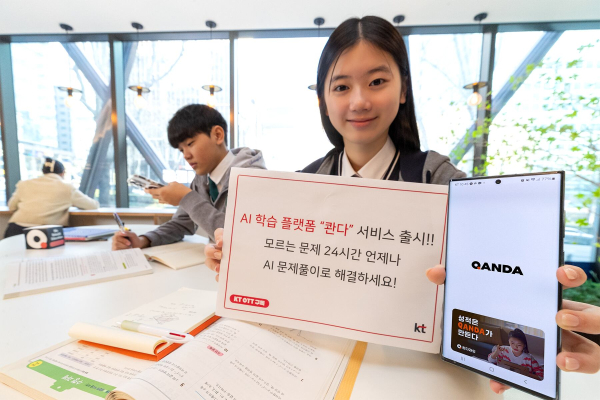
In education, KT will work with EBS and Mathpresso to improve AI-based learning services. Mathpresso’s QANDA platform has approximately 97 million registered users worldwide and about 8 million monthly active users, giving the consortium an established channel through which personalised AI learning can reach a large audience.
The companies plan to develop services that adapt explanations, exercises and learning paths to each student’s level, progress and questioning patterns. This could move educational AI beyond answering isolated questions towards supporting a continuous learning process shaped by the individual student’s needs.
In shopping, KT will cooperate with Musinsa, which has approximately 17 million users and around 8 million monthly active users. Personalised recommendations and conversational search could allow customers to find products based on occasion, style, budget or preference even when they do not know the precise product name or category.
ConnectWave, which operates the Danawa, Enuri and Makeshop e-commerce platforms, will examine the use of AI in product discovery, price comparison and merchant services. Daum and Saltlux will focus on search and information retrieval, while Zigbang will explore applications that support property research and housing decisions. BC Card and DeepSearch will work on AI-assisted financial information and related services.
The approach is not simply to add another generative AI window to each platform. It is intended to place AI inside the search, comparison and decision-making processes that users already perform, reducing the need to locate a separate AI service, create another account or learn a new interface.
KT plans to connect these consumer services with domestic models and platforms, Rebellions’ AI processors, and its own cloud and telecommunications infrastructure. Under this full-stack structure, service companies provide established customer relationships, model developers supply the intelligence layer, and semiconductor and cloud providers support the required computing capacity.
Mass adoption will depend on repeat use, not model size
The consortium’s most consequential asset may therefore be its distribution network rather than any single AI model. Global AI competition has largely been framed around parameters, computing scale and benchmark results. “AI for All” will instead test whether AI can deliver enough practical value to become part of people’s repeated daily behaviour.
Education, shopping, housing and finance differ substantially in their data structures, user expectations and costs of error. Applying one general-purpose model uniformly across these sectors would be insufficient. Each service will require its own combination of models and data, along with clear rules governing privacy, answer provenance, quality control and responsibility when errors occur.
The consortium’s performance will consequently depend less on the number of participating companies than on its ability to make different models, platforms and infrastructure work together reliably. Maintaining consistent service quality across this heterogeneous system will be one of the project’s most important technical and operational tests.
Free access alone will also not eliminate the AI divide. According to Korea’s 2025 Digital Divide Survey, 59.4% of the general population had used an AI service, compared with an average of 30.2% among four digitally vulnerable groups: people with disabilities, low-income households, farmers and fishers, and older adults.
Embedding AI within familiar education, financial and housing services could lower that barrier. It reduces the need for users to seek out a specialised platform and learn an unfamiliar way of interacting with the technology. Whether this produces broader inclusion, however, will depend on interface accessibility, trust and the relevance of the services offered—not simply their availability.
A further challenge is economic sustainability. Free AI can attract users quickly, but inference costs rise as usage expands. For the services to remain viable beyond government support, AI will need to generate measurable value by reducing customer-service costs, improving search and purchasing conversion, supporting better financial decisions or producing demonstrable learning outcomes.
“AI for All” is therefore more than a programme for distributing Korean AI models. It is a large-scale test of whether the country’s AI technologies can reach the services people use every day while proving their reliability, accessibility and economic value. KT’s strategy suggests that the next phase of AI competition will be determined not only by who builds the most capable model, but by who can place intelligence most effectively and securely within the routines of everyday life.
